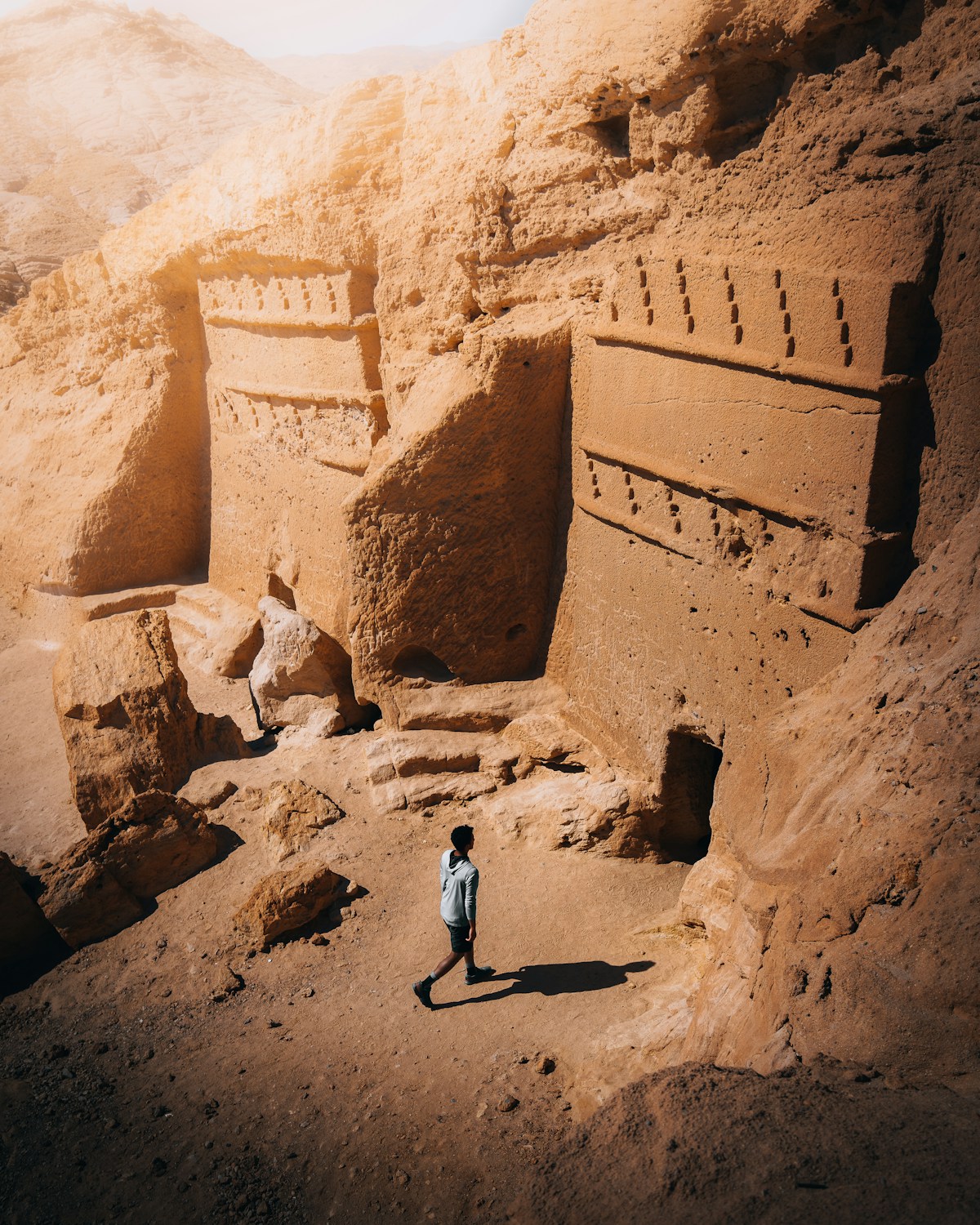
Najran occupies a valley in the far southwest of Saudi Arabia, surrounded by ochre mountains and date palm oases, close to the Yemen border. It is one of the least-visited cities in the kingdom by international tourists - and one of the most historically dense. The Al-Ukhdood ruins are directly Quranic in reference; the Najran Fort is among the best-preserved traditional fortifications in Saudi Arabia; and the regional museum covers a civilisational sequence that few visitors expect from a city this size.
Al-Ukhdood Archaeological Site
Al-Ukhdood - literally “the trench” - is an ancient pre-Islamic settlement dated to roughly the 1st century BCE through the 6th century CE. It was a significant trading settlement in ancient South Arabia, positioned on the caravan route between Yemen and the Hejaz.
The site’s Quranic connection is profound: Surah Al-Buruj references the “People of the Trench” - believed by many Islamic scholars to refer to the Najran massacre of early Christians by the Himyarite king Dhu Nuwas in approximately 523 CE. The archaeological site shows the ancient city layout, ruined structures, and ancient South Arabian inscriptions carved into stone.
Entry to the outdoor archaeological area is free. A visitor centre at the entrance provides context in Arabic and English. Opening hours follow general government facility schedules - approximately 09:00–13:00 and 16:00–21:00, with prayer-time closures. Allow 60–90 minutes for a thorough visit. Located approximately 2 kilometres west of the city centre; accessible by car or Uber.
Najran Fort (Qasr Al-Imara)
The Najran Fort - also called the Emirate Palace or Al-Imam Turki Palace - is a large mud-brick fortification complex in the heart of the city. Originally built in the 1950s as the seat of the Najran emirate, it incorporates traditional Asiri-Yemeni architectural elements: tall mud-brick towers, decorative wood-framed windows, and multi-storey facades with patterned earthwork.
The fort is open for visits, generally Saturday to Wednesday during the cooler parts of the day. Entry is free or at a nominal charge (confirm locally as of 2026). The interior courts and tower rooms give the best sense of traditional Najrani architecture. The exterior, particularly at golden hour, is among the most photogenic structures in southwestern Saudi Arabia.
Najran Regional Museum
Located in the city centre, the Najran Regional Museum houses a comprehensive collection covering the area’s history from the Neolithic period through the Islamic era. Exhibits include pre-Islamic artefacts (pottery, tools, weapons, jewellery), Himyarite-era inscriptions, ancient manuscripts, and traditional Najrani crafts.
Opening hours approximately Saturday to Thursday 09:00–13:30 and 17:00–21:00, closed Friday. Admission is free. The museum is well-organised and the signage is in both Arabic and English - one of the better-curated regional museums outside the main Saudi cities. Allow 60–90 minutes.
Traditional Yam Village Architecture
The Najran valley contains several traditional villages where the mud-brick and stone tower architecture unique to the Yam tribal area is still intact. The villages of Al-An and Al-Aqaba (outside the main city, in the surrounding valley) have clusters of traditional homes and towers, some still occupied. This is not a formal tourist attraction - there is no entry fee, signage, or café - but driving through the valley with stops at viewpoints gives a strong sense of the architectural tradition that distinguishes Najran from any other Saudi city.
Najran Souq and Date Market
Najran is a significant date-producing area, and the central souq reflects this. The market - concentrated near the old commercial centre - sells Najrani dates, locally woven textiles, and traditional Yemeni-influenced goods not easily found elsewhere in Saudi Arabia. The incense section of the souq (frankincense and myrrh resins, traditional oud) is the most distinctive commercially.
The souq is most active in the mornings and after Asr prayer (mid-afternoon). Full activity approximately 08:00–11:30 and 16:30–21:30.
To make the most of your visit, browse Tours in Najran for guided experiences, sort travel insurance before you depart, and pick up a Saudi eSIM for easy navigation on the ground. Browse hotels in Najran — the city’s accommodation puts you close to Al-Ukhdood, the fort, and the traditional souq.
Practical Details
Getting around: Uber is available in Najran but coverage is thinner than in the major Saudi cities. A rental car from the airport is the most flexible option for visiting Al-Ukhdood, the surrounding villages, and the museum across one or two days.
Climate: Najran’s elevation (approximately 1,200 metres) moderates the heat significantly. Summer temperatures reach 35–38°C rather than the 45°C+ of Riyadh or Jeddah. Winters (December–February) are mild by day (18–22°C) and cool at night. The most comfortable visiting period is October through March.
Border proximity: Najran is approximately 50 kilometres from the Yemen border. The city itself is fully normal for visitors; certain specific districts closer to the border may have access restrictions. Check current advisories before planning travel beyond the main city.