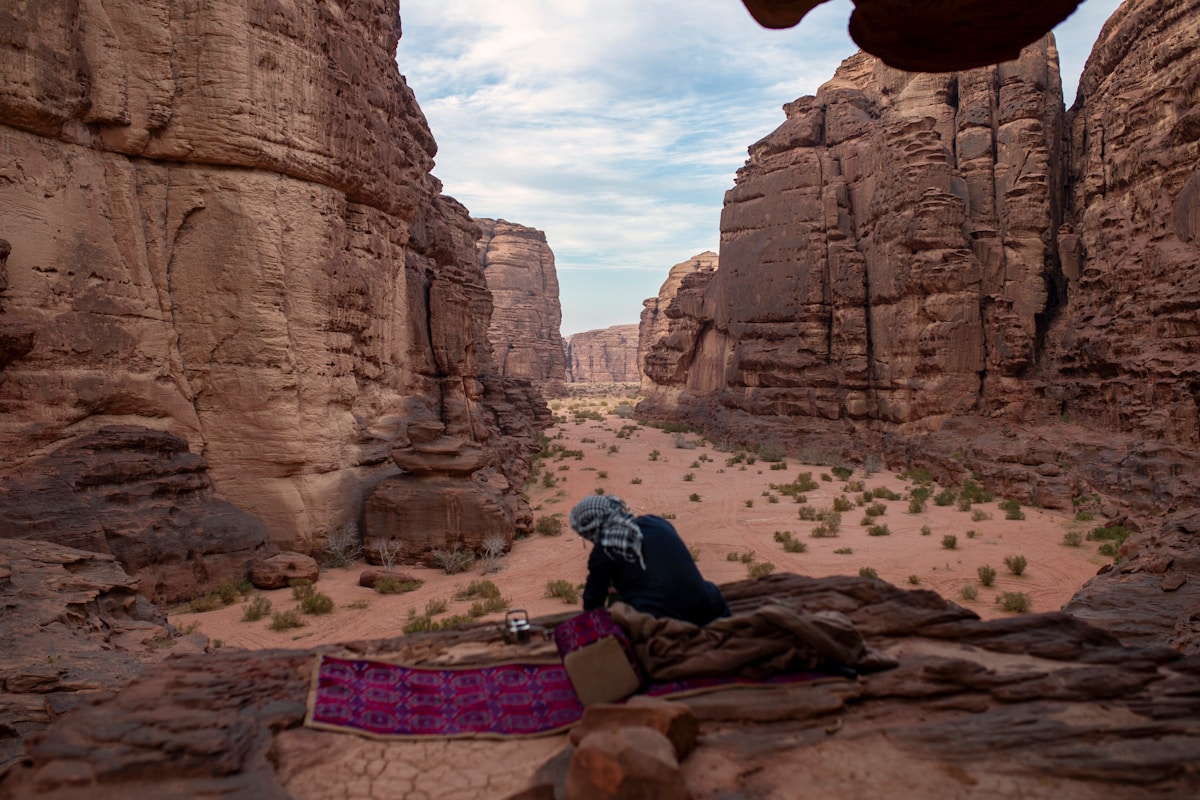
The Arabian Peninsula has been home to nomadic Bedouin tribes for at least four thousand years. Long before oil wells and highways redrew the map, these desert peoples organised themselves into intricate tribal networks stretching from the Hejaz mountains along the Red Sea coast to the vast sand seas of the Rub al Khali in the south and the central plateau of Najd.
The Tribes That Built a Nation
The three great heartlands of Bedouin Arabia each shaped a distinct tribal character. Najd, the austere central plateau around modern Riyadh, produced the Anaza confederation — one of the largest tribal groupings in the Arab world, from whom the Al Saud royal family traces its lineage. Hejaz, the western highlands bordering the Red Sea, was a crossroads of trade and pilgrimage that gave tribes access to wealth and ideas flowing between Africa, the Levant, and the Persian Gulf. The Rub al Khali — the Empty Quarter, at 650,000 square kilometres the world’s largest continuous sand desert — produced the hardest nomads of all: tribes like the Murra who navigated its shifting dunes with no fixed landmarks, guided entirely by stars and inherited oral knowledge.
These were not isolated communities. Bedouin tribes controlled the caravan routes moving frankincense, dates, and livestock across the peninsula, extracting protection fees and trade concessions that made tribal leadership simultaneously political and economic. The camel was the engine of this economy — a source of milk, meat, and transport — and ownership of the finest racing lines conferred status that persists in Saudi culture today.
Life Under the Tent: Tents, Camels, and Diyafa
Traditional Bedouin existence was organised around the bayt al-sha’r — literally “house of hair” — a woven goat-hair tent that could be dismantled and loaded onto camels within the hour. The tent was divided by a central partition: the men’s receiving area (marbad) on the right, the family’s private quarters on the left. Loosely woven fabric breathed in summer heat while tightening against desert rain.
At the centre of Bedouin social life sits the code of diyafa — the law of hospitality. Under diyafa, a host is obligated to provide food and protection to any guest who arrives, even a sworn enemy, for a minimum of three days. To refuse hospitality is among the gravest social disgraces in Arabian culture. The ritual begins with freshly ground cardamom coffee (qahwa) poured from a long-spouted dallah pot into small handle-less cups, offered at least three times. Dates follow, then whatever food the household can provide.
Camel culture permeates every layer of traditional Bedouin life. Classical Arabic contains over a hundred words describing camels by age, sex, coat colour, and gait — a vocabulary that reflects how central the animal was to survival. Today, camel racing remains a major cultural event across Saudi Arabia, with prize money at top events reaching into the millions of riyals. The annual King Abdulaziz Camel Festival near Riyadh draws hundreds of thousands of visitors and participating tribes from across the Gulf.
Bedouin Culture in Modern Saudi Arabia
Saudi Vision 2030 has invested heavily in preserving and presenting Bedouin heritage, funding restoration at tribal gathering sites and integrating traditional practices into cultural tourism.
Diriyah, the ancestral home of the Al Saud on the edge of Riyadh, is now a UNESCO World Heritage Site — the At-Turaif District was inscribed in 2010. Entry to the At-Turaif core site costs approximately SAR 95 per person (as of 2026), open daily from 9am to 11pm. It sits about 25km northwest of central Riyadh, roughly 35 minutes by car or ride-hailing app.
In rural Najd, traditions remain living rather than curated. Families in Al-Qassim and Ha’il continue to observe diyafa in its full form — guests arriving unannounced at farms and guesthouses are still welcomed with coffee and a meal before any questions are asked. Nabati poetry, a vernacular oral tradition rooted in Bedouin life, remains widely practised; competitions are broadcast nationally and draw audiences comparable to major sporting events.
UNESCO Recognition Efforts
Saudi Arabia has pursued multiple UNESCO nominations connected to Bedouin and traditional Arabian culture. The majlis — the sitting council where community decisions are made and guests are received — was inscribed on the Representative List of the Intangible Cultural Heritage of Humanity in 2015, a joint nomination with the UAE, Qatar, and Oman that recognised the practice as shared Gulf heritage.
Arabic calligraphy was inscribed in 2021, reflecting the deep link between Bedouin oral culture and the visual art that emerged from Islamic scholarship. Discussions are ongoing around nominating nabati poetry as a standalone element, supported by Saudi Arabia’s existing framework for documenting oral traditions across Najd and Hejaz.
The Al-Ahsa Oasis, inscribed in 2018, anchors the cultural landscape of the Eastern Province — a region where Bedouin and settled agricultural communities have coexisted and traded for centuries.
Where to Experience Bedouin Hospitality Today
Visiting a museum is one thing. Sitting inside a traditional tent while a host pours qahwa and the desert cools after sunset is another.
Ushaiqer Heritage Village, 240km northwest of Riyadh in Al-Qassim region (approximately 2.5 hours by car via Highway 65), is one of Saudi Arabia’s most intact traditional mud-brick villages. Its lanes, mosques, and merchant houses date to the 16th century. Entry to the village is free; the small folk museum charges approximately SAR 15 (as of 2026), open daily 9am–9pm (Friday from 4pm). This is rural Najd as it appeared before modernisation — unpaved alleys, date palms, and gypsum-decorated doorways.
Rijal Almaa Heritage Village, around 50km west of Abha in the Asir mountains (approximately 45 minutes via the Abha–Jizan road), offers a contrasting mountain Bedouin experience. Multi-storey stone-and-clay towers cling to a steep hillside, and the site’s museum spread across three ancient buildings displays weapons, jewellery, and household artefacts from highland tribal life. Entry approximately SAR 25 (as of 2026), open Saturday–Thursday 9am–6pm and Friday 4pm–9pm.
For overnight desert experiences, two tiers of operator cover different budgets. Riyadh-area desert camps — multiple operators run evening Bedouin experiences toward Al-Thumamah north of the city — offer Arabic coffee, dates, a traditional lamb dinner, and often a camel ride or falconry demonstration. Prices run from approximately SAR 280–450 per person for an evening (as of 2026); overnight packages add approximately SAR 180–300. Bookable through GetYourGuide or local operators along King Khalid Road in Riyadh.
For a deeper immersion, Experience AlUla (experiencealula.com) — the Royal Commission for AlUla’s official booking platform — lists overnight desert camp packages in the Hejaz highlands outside AlUla. Prices start from approximately SAR 1,400 per person (as of 2026), including camel trekking, a multi-course traditional dinner prepared fireside, storytelling with a local guide, and breakfast at sunrise. AlUla is 340km from Medina — approximately 3.5 hours by car via Highway 375.
Practical notes for visitors: Dress conservatively at Heritage Villages — local families still live in surrounding areas. Desert camps cool sharply after dark between October and April; bring a light layer. Ramadan evening camps are a particular highlight, when the iftar meal after sunset brings Bedouin hospitality into its fullest expression.
The code of diyafa has outlasted empires, oil booms, and the smartphone. In the Saudi desert, the coffee pot is still the first thing off the fire.