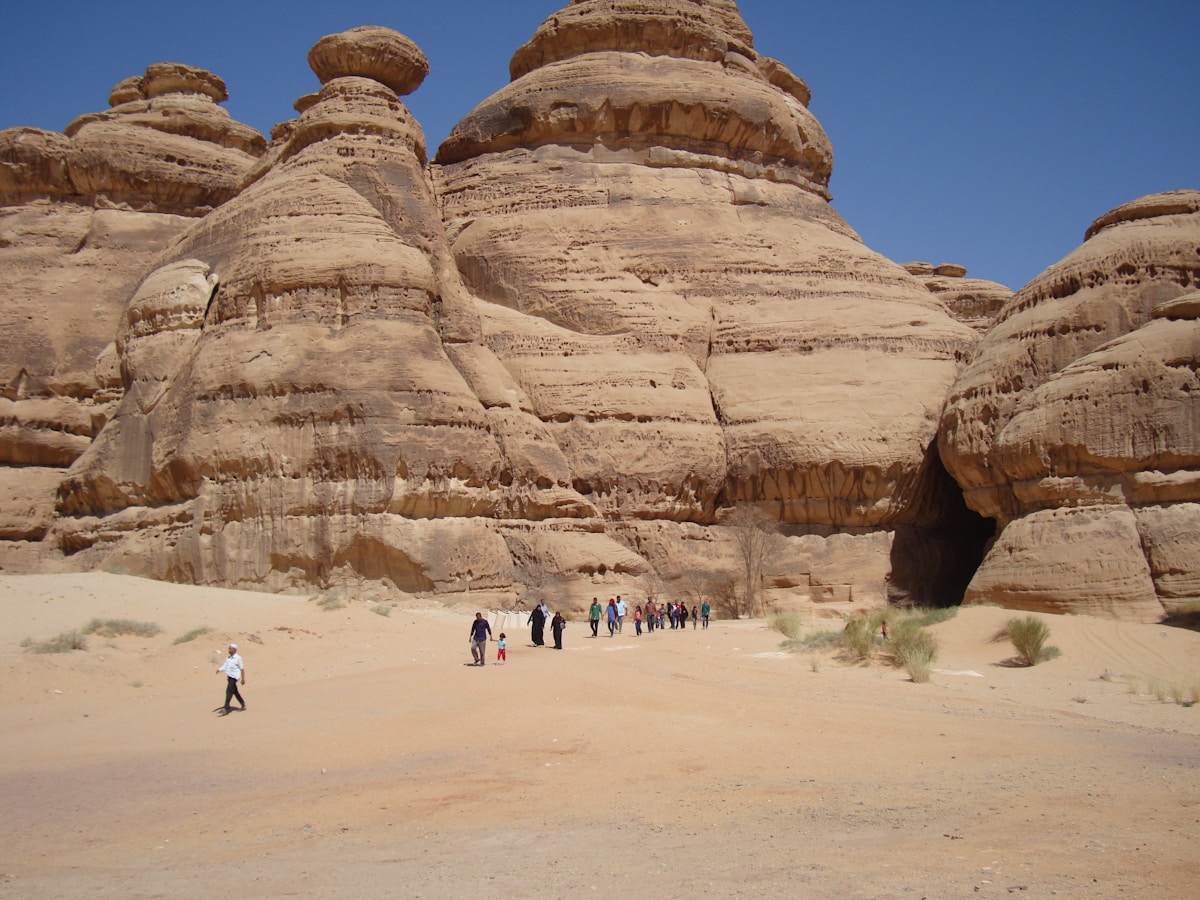
Hegra - historically called Madain Saleh and known in ancient times as Hegra or Egra - is the most significant archaeological site in Saudi Arabia. A Nabataean city of 111 carved-rock tombs, it was the southern outpost of the Nabataean Kingdom whose capital was Petra in modern Jordan. It became Saudi Arabia’s first UNESCO World Heritage Site in 2008 and only opened to international tourists in 2019.
The Nabataean Kingdom
The Nabataeans were an ancient Arabian people who built a trading empire across what is now Jordan, the Negev, Sinai, and northwestern Arabia. Their cultural peak ran from approximately the 4th century BC to the 1st century AD, when the Roman Emperor Trajan formally annexed their kingdom in 106 CE.
Hegra served as the Nabataean Kingdom’s southernmost major city - a commercial hub on the frankincense and spice trade route connecting southern Arabia with the Mediterranean. The city’s location in the AlUla Valley, with reliable water from underground aquifers, made it a natural waystation on this ancient trade network. The Nabataean period at Hegra ran from approximately 100 BCE to 100 CE - the site’s occupation spans the northernmost and southernmost reaches of Nabataean power simultaneously.
The Tombs
The 111 tombs at Hegra are carved directly into sandstone rock faces and outcrops. They range from relatively simple shaft graves to monumental funerary monuments with elaborate facades - pilasters, capitals, friezes, and Nabataean inscriptions identifying the tomb owner and date. The site organises into four main groupings, each associated with a different rock outcrop or hillside.
Qasr al-Farid (the Lonely Castle) is the most photographed tomb - a massive monument carved from a single isolated sandstone boulder, with a facade 22 metres high. The tomb was never completed; the lower portion was abandoned mid-carving, leaving visible tool marks in the stone. This incompleteness is part of what makes it so striking - the evidence of human craft arrested mid-process.
Jabal al-Ahmar has the highest concentration of large-scale tombs with decorated facades. The morning light on this cluster of outcrops is particularly dramatic - a 7–8am arrival gives the best conditions.
Jabal al-Banat (Mountain of Girls) contains tombs associated with female family members of prominent Hegran citizens.
The Diwan - a ceremonial meeting chamber cut directly into the rock - is a highlight often missed on rushed tours. The chamber served as a communal space for funeral rites and commemorative gatherings. Its interior dimensions and the precision of the cutting are remarkable.
The tombs are not burial chambers in the conventional sense - they were constructed above-ground as prestige monuments and funerary spaces, influenced by Hellenistic architectural motifs that the Nabataeans adapted into their own distinctive style. Look closely at the carved facades: many still retain traces of original paint in the recessed areas, evidence of the vivid decoration that would have characterised the site in its active period.
Hegra vs Petra: A Direct Comparison
Both sites are products of the same civilisation and the same period, and the comparison is worth making directly.
Scale: Hegra covers a larger area than Petra’s main monument zone. The 111 tombs are spread across multiple outcrops over several kilometres.
Crowds: Petra receives over 500,000 visitors annually. Hegra, despite rapid growth since 2019, sees a fraction of that number. The relative quiet changes the experience significantly - you can sit at Qasr al-Farid in near-silence where Petra’s equivalent (the Treasury) is always crowded.
Preservation: Hegra’s facades are in some ways better preserved than Petra’s - the Arabian interior climate has been kinder to the carved surfaces. Many facades still have sharp detail that Petra’s more exposed monuments have lost.
Context: Petra grew into a major urban centre with infrastructure to match. Hegra was always a provincial city - its scale is more intimate and its setting in the open AlUla Valley more immediately readable.
Visiting Hegra: Practical Information
Booking: All visits to Hegra require advance booking at experiencealula.com. This is the official AlUla experience platform for the on-site managed tours. For guided day trips from AlUla town - including transport, a local expert guide, and access coordination - browse AlUla tours and experiences. Spaces fill quickly during the October–March peak season; book at least 2–3 weeks ahead.
Entry: SAR 195 per adult, SAR 95 per child (as of 2026). The price includes the guided tour and shuttle transport.
Tours: Guided tours depart from the Welcome Centre, located approximately 15km from the main tomb area. The Welcome Centre is the logistical hub for all AlUla heritage sites - shuttles from here serve Hegra, Dadan, and Jabal Ikmah. The standard Hegra tour uses electric golf carts and covers the main tomb clusters over approximately 3 hours.
Photography: Permitted throughout Hegra, including inside tomb interiors where accessible. The pre-dawn golden light on the sandstone facades is exceptional. A 7–8am departure from AlUla town is recommended for the best lighting conditions at the site.
What to bring: Water (the site has food and drink kiosks at the Welcome Centre but nothing within the site itself), sun protection, and layering for early morning visits in winter. The site is exposed - wind can be significant at dawn.
The Wider AlUla Landscape
Hegra sits within the broader AlUla region, which contains other significant sites - the Dadan ruins (an older pre-Nabataean kingdom with carved lion tombs), Jabal Ikmah (an ancient open-air library of rock inscriptions), and Elephant Rock (Jabal al-Fil). A 2-night minimum stay in AlUla is needed to give Hegra the time it deserves while also covering the region’s other key sites. See the full AlUla heritage guide for the complete picture.
Planning Your Visit
Browse AlUla tours and packages for current Hegra tour options and airport transfer services from Jeddah or Riyadh. Before your trip, arrange travel insurance for Saudi Arabia, a local eSIM for connectivity, and confirm your airport-to-AlUla transfers in advance.
See Also
- AlUla City Guide - accommodation, transport, and practical planning for the region
- AlUla Things to Do - Dadan, Elephant Rock, and Jabal Ikmah alongside Hegra
- AlUla Heritage Guide - the full story of Dadan, Lihyan, and Nabataean kingdoms
- AlUla Tours Guide - named operators and prices for Hegra tours
- AlUla Hotels - accommodation options for the October–March season
- AlUla 3-Day Itinerary - structured day-by-day plan including Hegra
- Winter at Tantora Festival - Hegra by Night experience during the festival season
- Best time to visit Saudi Arabia - October to March for heritage touring