AlUla is one of the most immersive heritage destinations in the Middle East - a valley where ancient kingdoms, Nabataean tombs, and sandstone landscapes come together in a setting that few parts of the world can match. This guide covers the main experiences and how to approach each.
Hegra: The Nabataean Tombs
Hegra is AlUla’s defining site. The 111 rock-cut Nabataean tombs - carved into sandstone outcrops between the 1st century BC and the 4th century AD - are Saudi Arabia’s first UNESCO World Heritage Site and the main reason international visitors come to AlUla.
How to visit: Tours depart from the AlUla Welcome Centre by electric golf buggy. Pre-book at nusuk.sa or through an authorised tour operator. Tours cover the main clusters - Qasr al-Farid (the Lonely Castle), Jabal al-Ahmar, and Jabal al-Banat. Allow 3 hours including transport.
Best time: Dawn or late afternoon for the best light on the sandstone facades. Summer midday is impractical - intense heat.
For the full historical context, see the Hegra guide.
Dadan and Jabal Ikmah
Dadan - the ancient capital of the Dadan and Lihyan kingdoms that preceded the Nabataean period - is closer to the town of AlUla. The site includes carved lion tombs in the cliff face and ancient inscriptions. Archaeological excavation is ongoing; visible ruins are partial but significant in context.
Jabal Ikmah is described as the open-air library of ancient Arabia - a sandstone mountain face covered with thousands of inscriptions in multiple scripts (Lihyanite, Nabataean, Thamudic, and early Arabic). The density and variety of inscriptions here is extraordinary. Guided access is required.
Both sites are managed by the AlUla Welcome Centre. Book through our AlUla tours page.
Elephant Rock (Jabal al-Fil)
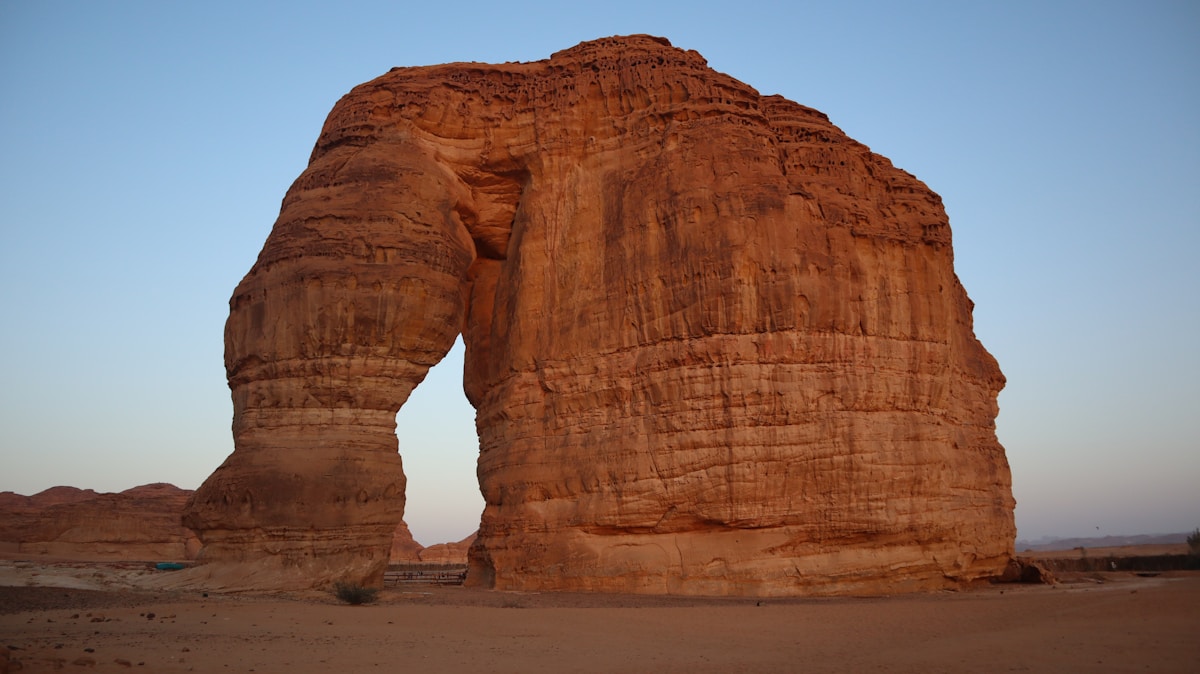
One of the most photographed natural formations in Saudi Arabia. A massive sandstone boulder, shaped by erosion over millions of years into the unmistakable form of an elephant - complete with a natural arch that forms the “legs.” The formation is approximately 50 metres high.
Visit at sunset: the rock turns deep orange-red in the golden hour and is surrounded by desert landscape. The site has been developed for tourists - there is a cafe and lighting at night. 45 minutes from the town centre by car.
The Old Town of AlUla
The abandoned mud-brick old town of AlUla sits in the valley floor - inhabited until the 1980s, when residents moved to the modern town. The compact settlement has traditional mud-brick architecture, a mosque, and narrow lanes. Partially restored sections are walkable. The contrast between the ancient Nabataean tombs on the cliff faces and the more recent mud-brick town below is a compelling illustration of AlUla’s layered history.
Harrat Uwayrid and Star Dunes
The volcanic lava fields of Harrat Uwayrid to the north of AlUla, and the star dune fields in the surrounding desert, can be explored by organised 4WD tour. The lava field landscape is stark and otherworldly - black rock over red sand. Star dunes (dunes shaped by winds from multiple directions) are some of the most complex and visually striking dune forms in Arabia.
Overnight desert camps in the dune fields are available - stargazing in AlUla’s dark skies, far from city light pollution, is outstanding. Book camping and dune driving tours through our AlUla tours page.
Winter at Tantora Festival
From December through March, AlUla hosts the Winter at Tantora cultural festival - concerts, art installations, food events, and guided heritage tours. The Maraya concert hall (a mirrored building visible from the valley) hosts headline events. Check the current programme and book tickets early - major events sell out.
See Also
- AlUla city guide - accommodation, transport and practical planning
- AlUla Heritage guide - the deep history of the valley and its kingdoms
- Hegra (Madain Saleh) - the Nabataean rock-cut tombs explained in full
- 3-day AlUla itinerary - day-by-day guide covering all the main sites