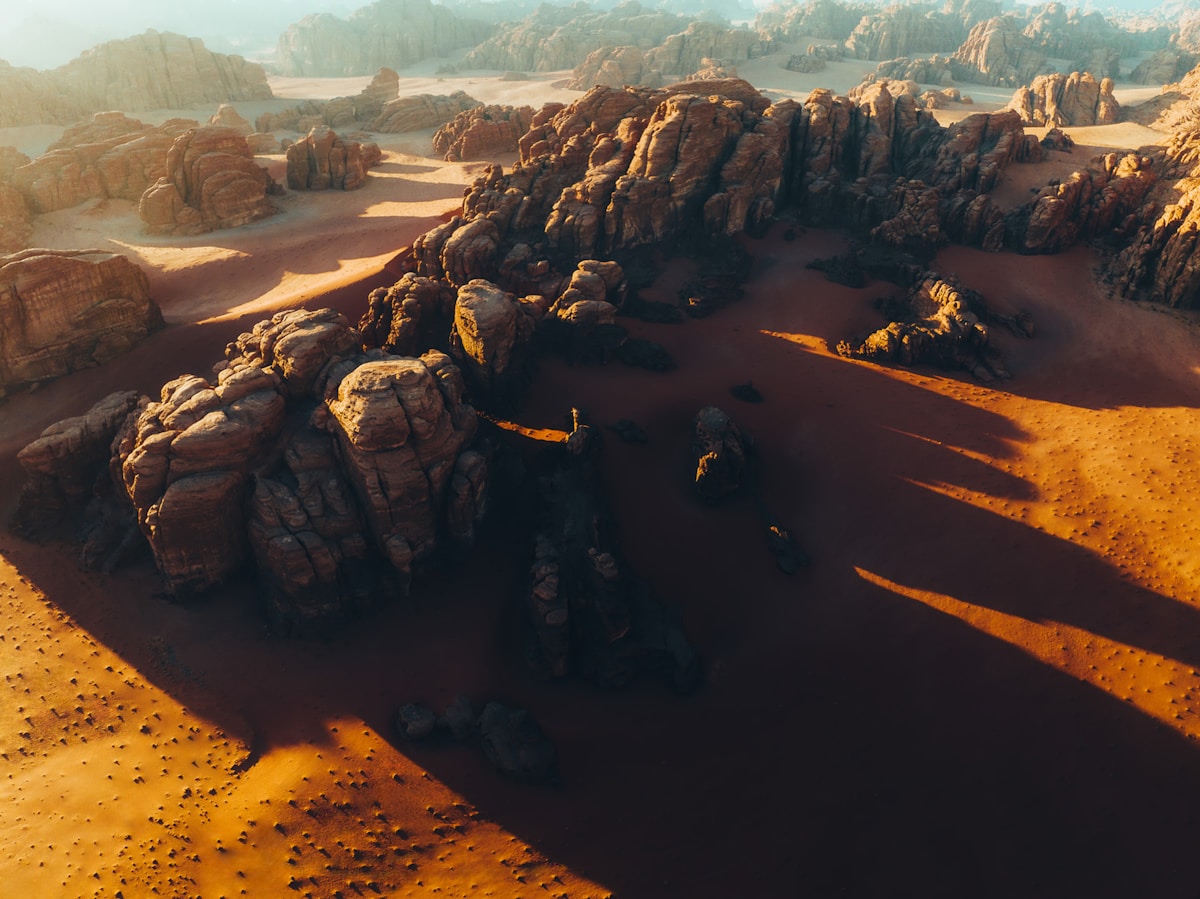
AlUla is not a single site - it is a region with 7,000 years of continuous human habitation, containing the physical remains of at least four distinct ancient cultures: prehistoric Arabian pastoralists, the Dadan Kingdom, the Lihyan Kingdom, and the Nabataean Kingdom. Understanding this sequence makes a visit to AlUla significantly richer than simply seeing the Nabataean tombs at Hegra.
Prehistoric AlUla
The AlUla Valley has evidence of human habitation dating to at least the 5th millennium BC. The valley’s geography explains this continuity: underground water from the Hejaz Mountains sustains date palm cultivation, the valley floor is fertile compared to surrounding desert, and the sandstone cliff faces provide natural protection and canvas for artistic expression.
Rock drawings and ancient graffiti on the valley walls predate all the named kingdoms. Stone tools, hearths, and ancient campsites in the surrounding desert indicate a much longer human history in this landscape.
The Dadan Kingdom
Dadan was one of the most powerful commercial states in ancient northwestern Arabia. The Dadan Kingdom, which controlled the AlUla Valley from approximately the 9th to the 6th centuries BC, is attested in ancient Near Eastern records including the Bible - the Dedanites appear in Genesis and Ezekiel as traders in luxury goods.
The capital city of Dadan occupied the same valley as modern AlUla. Its ruins - partially excavated - include temple structures and distinctive carved lion tombs cut into the cliff face above the city.
Dadan archaeological site: The site has been open to visitors since 2024. Tours start from approximately SAR 60 per person for the standard Dadan and Jabal Ikmah combined tour as of 2026; a premium private 4x4 experience runs approximately SAR 1,000 per vehicle. Note that self-drive to the Dadan site is not permitted — visitors must use organised coach transfers from AlUla’s Winter Park or book a premium 4x4 tour through experiencealula.com. Advance booking is strongly recommended as daily tour slots are limited; walk-up availability exists but is not guaranteed. Tours run year-round and last approximately two hours. The lion tombs are the visual centrepiece — large rectangular chambers carved into the sandstone cliff face at height, each fronted by carved lion relief figures. The site covers a wide area; the shuttle or 4x4 brings visitors to the main excavation zones and the lion tomb viewpoint. Allow 1.5–2 hours for the Dadan visit.
The Lihyan Kingdom
The Lihyan Kingdom succeeded the Dadan Kingdom in the same valley, flourishing from approximately the 5th to the 2nd centuries BC. The Lihyanites developed a distinctive writing system (Lihyanite script, a variant of Ancient South Arabian) and produced remarkable stone sculpture - most notably large carved stone busts with distinctive facial features.
Lihyanite inscriptions are scattered across the AlUla Valley and surrounding area, particularly concentrated at Jabal Ikmah. These inscriptions range from royal dedications to votive texts to the ancient equivalent of graffiti.
Jabal Ikmah: The Open-Air Library
Jabal Ikmah is arguably the most extraordinary heritage site in AlUla for those interested in ancient language. The mountain’s sandstone faces carry thousands of inscriptions in multiple scripts: Lihyanite, Minaic, Thamudic, Nabataean, and early Arabic forms. Some inscriptions are religious dedications; others record names of visitors who passed through; others are simply marks of presence. The concentration on a single sandstone hillside is extraordinary - walking the site feels like reading a palimpsest of 2,000 years of human passage.
The variety of scripts at a single location reflects AlUla’s position on the ancient trade route - travellers from different cultural backgrounds passed through and left their marks. Jabal Ikmah is included in most AlUla tour packages via experiencealula.com and does not have a separate entry fee when booked as part of a combined tour. Access is always via guided arrangement - self-guided wandering is not permitted given the fragility of the inscriptions.
The Nabataean Period at AlUla
The Nabataeans arrived in the AlUla Valley around the 1st century BC, building their southern city Hegra on the northern end of the valley. Hegra became a significant commercial centre on the incense trade route - a stopping point for caravans carrying frankincense and myrrh from southern Arabia to the Mediterranean. The Nabataean period at AlUla (approximately 100 BCE–100 CE) represents the northernmost extension of Nabataean power beyond Petra into Arabia - an important distinction from the conventional reading of Nabataean territory as centred in what is now Jordan.
For the full account of Hegra’s Nabataean tombs, see the Hegra guide.
AlUla Old Town
The old town of AlUla sits in the valley below the ancient sites - a compact mud-brick settlement built over many centuries and inhabited until the 1980s, when residents relocated to the modern town. The abandoned old town has been partially restored and can be explored on foot at no charge. Some of the restored buildings have been converted into small cafes and galleries - it is the kind of heritage walking environment that functions well in the early morning or late afternoon when the light is low and the temperature comfortable.
The old town represents the most recent historical layer in a landscape of extraordinary depth. The mud-brick architecture is recognisably related to the Najdi building tradition found at Diriyah - the same materials and structural logic, adapted to the AlUla valley context.
Planning Your AlUla Heritage Visit
A minimum of two full days is needed to cover AlUla’s heritage properly. The recommended structure:
Day 1: Hegra (morning, 3 hours guided tour), AlUla Old Town (afternoon, self-guided walk), Elephant Rock (sunset).
Day 2: Dadan (morning, shuttle from Welcome Centre), Jabal Ikmah (mid-morning, guided), Jabal Ikmah combined tour, Maraya building (afternoon).
All bookings go through experiencealula.com - book before arriving in Saudi Arabia during the October–March peak season, as Hegra tours fill weeks in advance. The AlUla Welcome Centre coordinates all site shuttles and is the logistical hub for the region. Book additional tours through our AlUla tours page.
Planning Your Trip
For complete tour booking and planning, browse AlUla tours and heritage experiences. Before travelling, ensure you have travel insurance for Saudi Arabia and a local eSIM for connectivity across the region.
See Also
- AlUla City Guide - accommodation, transport, and practical logistics
- AlUla Things to Do - Dadan, Elephant Rock, and Jabal Ikmah in detail
- AlUla Tours Guide - operators, prices, and what to expect on a Hegra tour
- Hegra (Madain Saleh) - the Nabataean rock-cut tombs in full detail
- AlUla 3-Day Itinerary - structured day-by-day plan covering all main sites
- AlUla Hotels - Habitas, Banyan Tree, and Shaden Resort options
- Winter at Tantora Festival - cultural events at Maraya Concert Hall, December–March
- Best Time to Visit Saudi Arabia - October to March for AlUla heritage touring