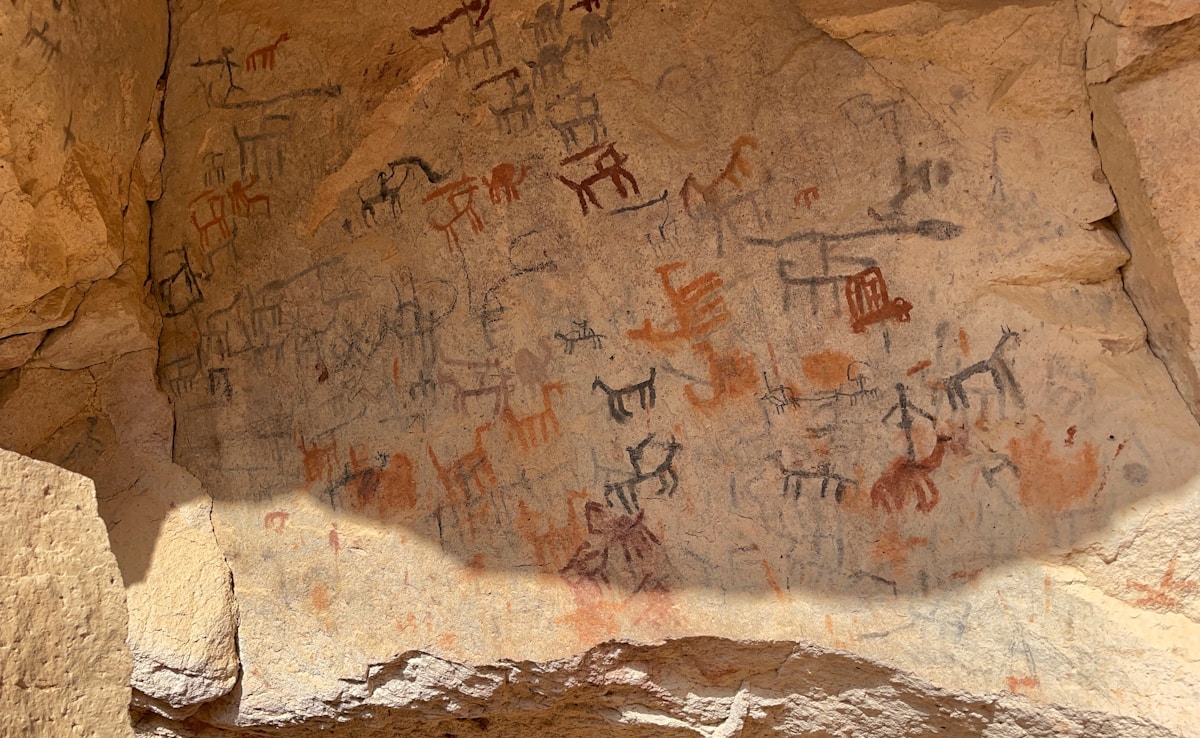
Jubbah is one of the most significant prehistoric sites in the Arabian Peninsula - a sandstone outcrop rising from the northern Saudi desert that was once the shore of an ancient lake and has served as a canvas for human expression for approximately 10,000 years.
The site holds thousands of petroglyphs - images carved into the rock surface - depicting a world that has disappeared: large animals that no longer exist in Arabia, human societies organised around hunting and herding in a landscape that was then grassland and lake shore rather than desert.
The UNESCO Inscription
The UNESCO World Heritage listing (inscribed 2015) covers both Jubbah and Shuwaymis under the designation “Rock Art in the Hail Region of Saudi Arabia.” The inscription recognises both sites as exceptional records of ancient human life and the changing climate of northern Arabia. Jubbah is the more accessible of the two sites and receives the majority of visitors. The Shuwaymis site, 200km southwest, requires a separate dedicated trip.
Approximately 10,000 individual carvings have been catalogued at Jubbah across the sandstone outcrop. The cataloguing work has been conducted over several decades and is ongoing - new carvings continue to be documented as earlier layers of rock surface are cleaned and examined.
The Ancient Lake of Jubbah
Understanding Jubbah requires understanding the Holocene climate of Arabia. Between approximately 11,000 and 5,000 years ago, the Arabian Peninsula was significantly wetter than today - a period scientists call the African Humid Period or the “Green Arabia” phase. Where northern Saudi Arabia is now hyper-arid desert, there were lakes, grasslands, and rivers. The rocky outcrop at Jubbah stood at the edge of a substantial lake.
People camped at this lake shore for millennia, and they carved images into the rock face of the outcrop. Some carvings depict animals that required this wetter environment. The Jubbah carvings include species that are now extinct in Arabia, including lions (extinct in Arabia for centuries) and wild asses. Crucially, some carvings appear at precisely the level of the ancient waterline - placing the human activity at the lake’s edge in a way that is geologically verifiable. Some carvings show humans in what appear to be boats or rafts, suggesting the lake was navigable and used for fishing or transport.
What the Carvings Show
The Jubbah petroglyphs have been catalogued over several decades of archaeological investigation. The range of subjects spans thousands of years of human activity:
Prehistoric period (approximately 8,000–5,000 years ago): Hunting scenes with humans and large game animals. Depictions of aurochs (wild cattle), ibex, gazelles, and ostriches. Some of the human figures carry bows and arrows.
Pastoral period: As the climate dried and hunting gave way to herding, the carvings show domesticated animals - particularly camels and horses - reflecting the transition to pastoralism. The shift from hunting scenes to herding scenes within a single site is a direct record of social and economic change driven by climate.
Later periods: Thamudic, Lihyanite, and Arabic inscriptions appear alongside and sometimes overlapping the earlier carvings, indicating continuous use of the site through the historical period. Some of these later inscriptions name individuals - one of the few places in northern Arabia where ancient personal names can be read in context.
Visiting Jubbah: Practical Information
Getting there: Jubbah is approximately 100km north of Ha’il city on the paved road toward the Saudi-Jordan highway. Journey time is 1.5 hours by car. There is no public transport - a rented car or taxi from Ha’il is required.
Opening hours: The visitor centre is open approximately 8am–5pm Saturday–Thursday as of 2026. Friday opening is uncertain — check with Ha’il’s Tourism and Heritage Authority before travelling, as hours can vary around public holidays and during summer months. The Saudi Heritage Commission (heritagecommission.gov.sa) is the authoritative contact for current hours.
Entry and registration: Entry to Jubbah is free as of 2026. The site is managed by the Saudi Heritage Commission — check in at the visitor centre on arrival and bring a passport or Saudi ID. Registration takes approximately 5 minutes. The visitor centre provides a brief orientation to the site: expect a welcome with coffee and dates and a 20-minute overview of the history and layout before you set out to the carvings. No advance permit is required for the main viewing area, though some restricted sections may require prior coordination with the Heritage Commission.
Guides: A local guide can be arranged through the site office on arrival. Guides are informal, not official tour operators - the going rate is SAR 50 as of 2026–80 for a 2-hour visit. Engaging a guide is strongly recommended. The petroglyphs are distributed across a rocky outcrop and many of the finest carvings are not immediately visible from the main paths - a knowledgeable guide makes the difference between seeing 20 carvings and seeing 200.
Photography: Permitted. The best light for photography is early morning or late afternoon - low-angle light emphasises the carved lines against the shadow and makes the carvings dramatically more visible. Midday light washes out the carvings almost entirely. Plan your visit timing accordingly.
What to bring: Water (the site has no facilities - bring at least 2 litres per person), sun protection, comfortable walking shoes for rocky terrain, and a camera capable of detailed close-up work.
The Shuwaymis Site
The UNESCO listing includes Shuwaymis - a second major rock art concentration in the Hail region, approximately 200 kilometres southwest of Ha’il near the ancient pilgrimage route between Iraq and Mecca. Shuwaymis contains equally ancient carvings in a different landscape - smaller outcrops spread over a wider area in a more remote setting.
For serious rock art enthusiasts, visiting both sites is worthwhile but requires dedicated planning. Budget a full day from Ha’il for Shuwaymis, ideally with an experienced local guide who knows the site - the carvings at Shuwaymis are more dispersed than at Jubbah and harder to navigate independently. A local guide from Ha’il city can usually be arranged through the Heritage Commission office or through Ha’il’s tourism department.
Planning Your Visit
Browse Ha’il tours and heritage experiences for current Jubbah tour options and guides. Ensure you have travel insurance for Saudi Arabia and a local eSIM before your journey north from Riyadh.
See Also
- Hail City Guide - base city for Jubbah day trips and the wider Ha’il heritage circuit
- Things to Do in Hail - full guide to A’arif Fortress, Al-Hait, and the Nefud Desert
- Where to Stay in Hail - Radisson Blu, Casa Hotel, and budget accommodation
- Desert camping in Saudi Arabia - Nefud Desert camps accessible from Ha’il
- AlUla Heritage - the other Saudi UNESCO rock art heritage zone
- Hegra (Madain Saleh) - Nabataean tombs 400km south of Ha’il
- Buraydah City Guide - the Camel Festival city, useful for a northern Saudi circuit
- 2 Weeks in Saudi Arabia Itinerary - northern Saudi circuit including Ha’il and Jubbah