Winter at Tantora is AlUla’s annual cultural festival - a multi-month programme of concerts, heritage experiences, culinary events, and outdoor activities that runs through the cooler months of the Saudi winter. It is the primary event that puts AlUla on the international travel calendar and has drawn international performers and visitors since its launch in 2018. The festival makes use of AlUla’s extraordinary landscape - the ancient Nabataean city of Hegra, the sandstone canyons, and the clear desert night skies - as a backdrop for experiences that would be difficult to create anywhere else.
What Winter at Tantora Is
The name comes from a traditional Tantora instrument - a long reed flute associated with the Hijaz region - and from the ancient AlUla calendar, in which the winter season was guided by astronomical observation. The festival is organised by the Royal Commission for AlUla (RCU) and runs as a series of weekend events across a roughly four-month window.
It is not a single event but a programme with different components: some require separate tickets, some are included in general site access, and some are invite-only or limited capacity. Planning ahead is essential - the headline concerts in particular sell out quickly.
The Season and Dates
Winter at Tantora typically runs from December through March, with the peak of programming in January and February. The 2024–2025 season ran from December 2024 through March 2025; check the Royal Commission for AlUla’s website at experiencealula.com for the current season’s exact dates and event listings before booking travel. AlUla’s weather during this period - dry, mild days (15–25°C) and cool nights (5–12°C) - is some of the best in Arabia, which is partly why the festival was timed for winter.
Ramadan timing occasionally overlaps with the tail end of the festival season in March; verify dates carefully as programming is modified during Ramadan.
Concerts and Performances
Music has been the centrepiece of the festival since its founding. Past seasons have featured international artists across genres - classical orchestras performing in the canyon landscape, regional Arabic artists, world music acts, and electronic music events staged against the illuminated rock formations.
The main concert venue is the Maraya Concert Hall, a structure clad entirely in mirrored glass panels that reflect the surrounding desert - making it one of the most visually distinctive concert venues in the world. With a capacity of around 500, it is intimate for the scale of artists it has hosted.
Concert tickets in recent seasons have ranged from approximately SAR 150–800 depending on the act and seat category. Premium packages have included dinner before the performance. Tickets are released through experiencealula.com and sell out for headline events within hours - sign up for the RCU mailing list to receive advance notice. As of 2026, pricing structures vary by season; verify current ticket prices on the official website.
Hegra by Night
The Hegra by Night experience is one of the festival’s signature offerings: a guided evening tour of the Nabataean archaeological site with dramatic lighting installed across the tombs and rock formations. The site - Saudi Arabia’s first UNESCO World Heritage Site - is already remarkable by day; by night, illuminated against a dark sky, the carved facades take on a different quality entirely.
Tour duration: Approximately 2 hours. Capacity is limited and advance booking is essential - these experiences sell out days in advance during the peak festival period. Tickets are available through experiencealula.com; Hegra by Night and other AlUla festival experiences can also be booked via GetYourGuide. Prices in recent seasons have been approximately SAR 200–350 per person for the evening experience, though this varies by season.
The tour includes transport from the meeting point to the site in electric vehicles (no private cars inside Hegra), a guided walk through the main tomb areas, and return transfer. Dress warmly - AlUla’s winter nights drop to 5°C or lower, and the tour is conducted entirely outdoors.
Hot Air Balloon Flights
Hot air balloon flights over the AlUla landscape are available during the festival season, operated through the Royal Commission’s approved partners. The flight path typically covers the palm oasis, the old town of AlUla, and the sandstone rock formations at first light.
Flights depart at sunrise - typically 5:30–6am departure, with a 45–60 minute flight. Prices from approximately SAR 750–950 per person as of recent seasons. Book as far in advance as possible; weather cancellations are possible and the waiting lists can be long. The morning light in AlUla is particularly good - the golden sandstone amplified by the low angle of the sun - making the balloon timing well-chosen.
Culinary Experiences
The culinary programme at Winter at Tantora has grown significantly since the festival’s early seasons. The Royal Commission has brought in visiting chefs and established a number of dinner experiences that use AlUla’s landscape and local produce as their framework.
AlUla Feast: A multi-course dinner held in the canyon or oasis setting, with dishes drawing on Hijazi culinary traditions alongside international techniques. Prices for these dinners have run from approximately SAR 400–1,200 per person in recent seasons depending on the event format.
Ashar Resort dining: Several restaurants at the Ashar Resort (the main luxury property adjacent to the site) offer festival-season menus during Winter at Tantora. The outdoor setting at dusk, with the rock formations behind the resort, is worth booking even for a straightforward dinner.
Local Hijazi cuisine - slow-cooked lamb, date-based desserts, Arabic coffee with cardamom - is well-represented in the market and casual dining areas around the main festival hub.
Daytime Archaeological Experiences
Beyond the evening events, the festival season is the best time to visit AlUla’s main heritage sites - demand is high but so is the number of guides and available tours.
Hegra (Mada’in Saleh): The Nabataean city with over 100 carved rock tombs. Tours run throughout the day during the season. SAR 95–125 for a 3-hour guided tour as of 2026. Advance booking required; walk-in access is not permitted. Book through experiencealula.com.
Dadan and Jabal Ikmah: The ancient Lihyanite kingdom site and the open-air rock inscription library, accessed on guided tours from the Old Town. SAR 45–75 per person for guided access. Jabal Ikmah’s cliff face inscriptions in multiple ancient scripts are a genuinely unusual thing to see.
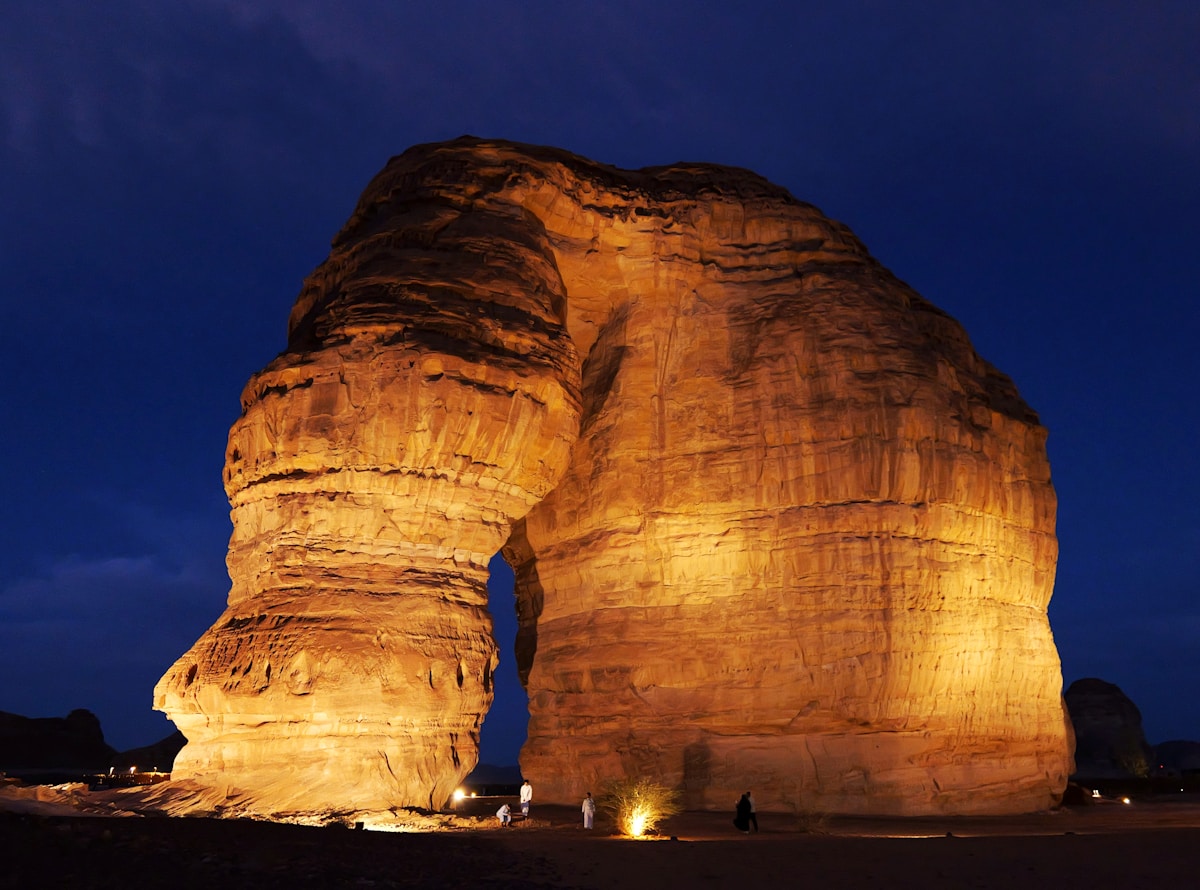
Elephant Rock (Jabal Al Fil): Open access year-round, free of charge. The rock formation - shaped naturally into a form that closely resembles an elephant with its trunk extended - is 40 minutes from the old town and accessible by car. Most impressive at sunset and after dark when it is illuminated.
Accommodation During the Festival
AlUla has limited accommodation relative to festival demand. Book as far ahead as possible - ideally six months in advance for the peak weeks in January and February. Given that festival tickets and hotel deposits are typically non-refundable, arranging trip cancellation cover early is sensible - compare travel insurance for Saudi Arabia.
Shaden Resort: Premium tented camp with individual tent structures set in the palm oasis. From approximately SAR 1,200–2,000 per night during the festival season. The setting is genuinely distinctive - the palm canopy above, the rock formations in the distance - and the on-site restaurant is one of the better options in AlUla.
Ashar Resort: A boutique luxury property adjacent to the main heritage sites, with 30 rooms positioned in the canyon landscape. From approximately SAR 1,500–2,500 per night in peak season. Consistently the most sought-after property in AlUla during the festival.
Habitas AlUla: An eco-resort focused on sustainable design, with dome structures set in the canyon. From approximately SAR 900–1,500 per night.
Midrange options: AlUla town and the surrounding area have smaller guesthouses and hotel properties from approximately SAR 350–600 per night. These fill quickly during the festival period.
Getting to AlUla for the Festival
By air: AlUla Airport (ULH) receives domestic flights from Riyadh (approximately 1 hour 40 minutes, SAR 200–450 return) and Jeddah (approximately 1 hour 20 minutes, SAR 180–380 return). Capacity is limited and seats on peak festival weekends sell out. Book flights and hotels together as early as possible - search Riyadh–AlUla flights on Aviasales.
By road from Riyadh: Approximately 700 kilometres north - around 7 hours. The route passes through Medina or Tabuk depending on the road taken. A long drive best suited to those who prefer travelling overland through the Hejaz landscape.
Getting around AlUla: A car is useful; most festival sites and hotels operate shuttle services during the event. Electric buggies run between the main tourist sites and the old town hub. An eSIM for Saudi Arabia keeps you connected from the moment you land - pick one up before departure.
See the full AlUla guide for year-round visiting information, or browse AlUla tours and activities including Hegra tickets, balloon flights, and festival packages.
See Also
- AlUla City Guide - transport, getting there, and year-round visiting information
- AlUla Things to Do - Hegra, Dadan, and Elephant Rock
- AlUla Hotels - Habitas, Banyan Tree, and Shaden Resort for the festival season
- AlUla Tours Guide - operator prices for Hegra and other AlUla site tours
- AlUla Heritage History - the Dadan, Lihyan, and Nabataean kingdoms of AlUla
- Hegra (Madain Saleh) - the Nabataean tombs central to the AlUla experience
- AlUla 3-Day Itinerary - day-by-day plan combining heritage and festival experiences
- Visiting Saudi Arabia in January - peak festival month guide
- Visiting Saudi Arabia in December - festival launch month guide