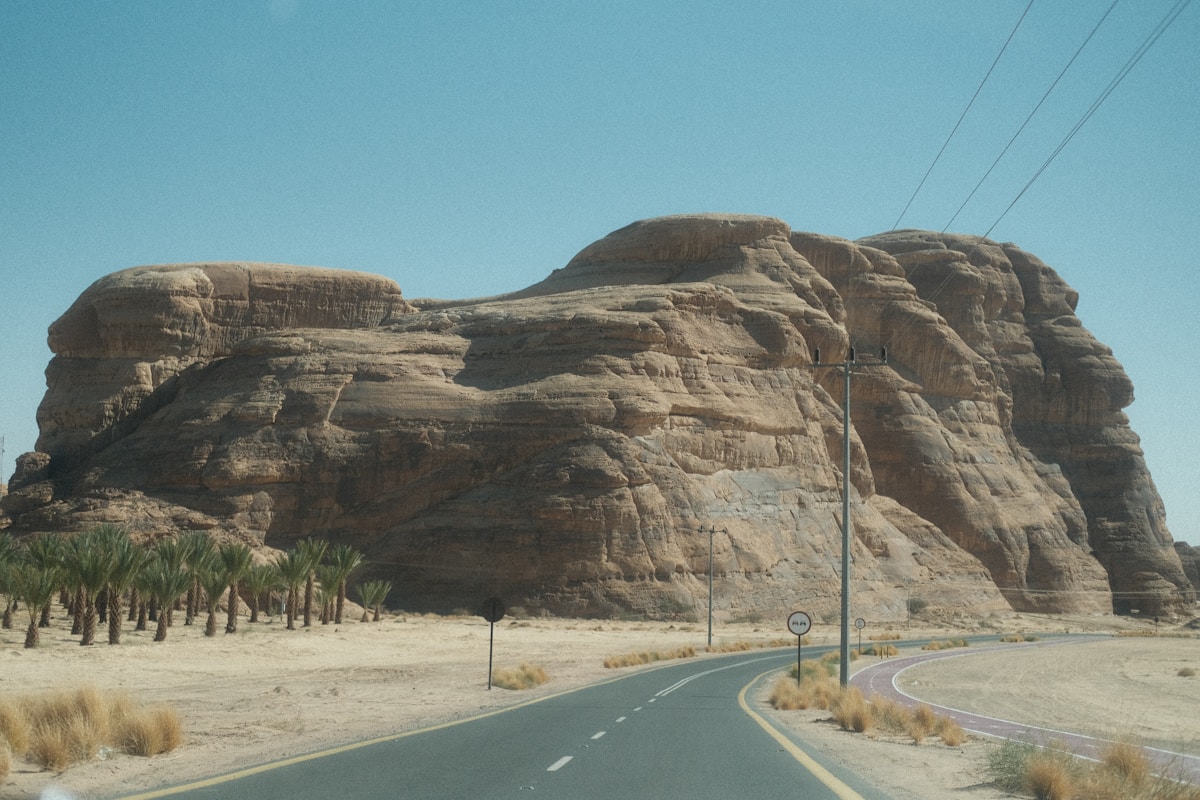
AlUla is compact enough that all four of its headline attractions are within 30km of the town centre. You could cover every one in a single long day, but splitting them across two days allows proper time at Hegra and a more relaxed experience throughout. Here is what to know about each.
1. Hegra (Madain Saleh) - 22km, 25 Minutes
Hegra is the most significant archaeological site in Saudi Arabia and one of the most important Nabataean sites outside Petra in Jordan. The ancient city contains over 100 monumental rock-cut tombs carved from sandstone outcrops, with elaborate façades decorated with inscriptions and zoomorphic carvings dating from the 1st century BCE to the 1st century CE. The sheer scale - some tomb façades are 20–25m high - is impossible to appreciate from photographs.
Getting there: Approximately 22km north of AlUla town via a paved road. Drive time 25 minutes. The Hegra Welcome Centre is the departure point for all tours; entry through the centre is mandatory.
Entry and booking: Tickets must be booked in advance at experiencealula.com. Entry is by guided tour only - the bus-and-walking format visits approximately 12 of the main tomb clusters over 2–2.5 hours. Ticket prices approximately SAR 195 per person as of 2026 (standard tour). Premium sunset and photography tours cost approximately SAR 350–450 as of 2026. No on-site ticket sales; book online before travelling.
Opening hours: Hegra is open to visitors most of the year, with seasonal adjustments. Typical daytime tours run 8am–4pm Saturday–Thursday, closed Friday mornings. Check experiencealula.com for current schedules - hours shift during Ramadan and peak season.
Photography: The warm light in the first two hours after sunrise and the last hour before sunset produces the best results on the tomb façades. Sunrise and sunset tours (premium tickets) are worth the additional cost if photography is a priority.
What to look for: The Tomb of Lihyan Son of Kuza is one of the largest and most photographed - its 22m carved façade includes classical Nabataean pilasters and a staircase entrance. The Jabal Al Ahmar cluster (red-tinted rock) and the Jabal Khraybah group offer the densest concentration of inscribed façades.
For a deeper history of the site, see our Hegra and Madain Saleh history guide.
2. Elephant Rock (Jabal Al Fil) - 11km, 15 Minutes
Elephant Rock is a 52-metre sandstone formation shaped, from one side, like an elephant lifting its trunk. The resemblance is precise enough that it is immediately recognisable - this is not a stretch of the imagination. The rock sits on an open desert plain north of AlUla with unobstructed views in all directions, and the Royal Commission has developed the area into a comfortable visitor destination with a café, seating, and lighting for evening visits.
Getting there: 11km north of AlUla Old Town on a paved road. Drive time 15 minutes. Free parking at the site. No entry fee.
Opening hours: Open 24 hours as of 2026. The café at the base of the rock operates approximately 9am–11pm daily (check locally for current hours).
When to visit:
- Sunrise: The rock glows orange-pink as the first light hits. The site is quiet at this hour - you may have it largely to yourself.
- Sunset: The most popular time. The rock turns deep amber as the sun drops behind the western ridge. Arrive 45–60 minutes before sunset for a parking space and a good position.
- Evening: The installed lighting illuminates the rock blue-white after dark and the effect is striking, particularly looking through the natural arch at the base of the formation. The café is open and the temperature is pleasant in the October–April season.
Photography tip: The elephant profile is most evident when viewed from the southwest - approach from the café side rather than the road approach for the clearest silhouette.
3. AlUla Old Town - In Town, No Drive
AlUla Old Town (البلد القديم) is a dense labyrinth of approximately 900 mud-brick houses built on a rocky plateau in the valley floor. The town was continuously inhabited for over 900 years until the 1980s, when residents moved to modern AlUla and the old city was abandoned. It has since been partially restored and is now a walkable heritage site within the town.
Getting there: Walk from the main AlUla town market area or drive 5 minutes. The Old Town entrance is on the main valley road; parking nearby.
Entry: Free access to the main alleyways. Some restored interior structures charge a small fee (approximately SAR 15–25 as of 2026). No booking required.
Opening hours: The outer alleyways are generally accessible during daylight. Some restored sections have limited evening openings during peak season (October–April). The AlUla Winter at Tantora festival (December–March) brings additional programming and lighting into the Old Town.
What to see:
- The 13th-century mosque at the heart of the Old Town - one of the oldest surviving structures in the Hejaz
- The citadel (Qal’at Musa’id) on the rocky outcrop above the town - steep climb, good views over the valley
- The carved mud-brick doorways and decorative window grilles, most of which are original
- The dried date palm gardens immediately south of the Old Town - still planted and harvested by local families
How long to allow: 1.5–2 hours to walk the Old Town thoroughly. Combine with the adjacent Souk Al Kharaj (a restored market of traditional shops) for another 30–45 minutes.
Guided options: The Royal Commission offers guided Old Town walks approximately SAR 80–100 per person as of 2026. Book at the AlUla Experience Centre or through experiencealula.com. A local guide significantly improves the visit - many of the most interesting features are inside structures not accessible on an unmarked self-guided walk.
4. Jabal Ikmah - 20km, 25 Minutes
Jabal Ikmah is a sandstone canyon containing the largest single collection of Nabataean and pre-Nabataean inscriptions in Arabia - hundreds of texts, names, dedications, and drawings covering the canyon walls for several hundred metres. The inscriptions date from approximately 500 BCE to 400 CE, spanning Lihyanite, Dedanite, Nabataean, and early Arabic scripts. Epigraphers call it one of the most important open-air inscription sites in the world.
Getting there: Approximately 20km north of AlUla town, adjacent to the Hegra road. Drive time 25 minutes on a paved road.
Entry and booking: Entry is included in the AlUla Experience Pass or bookable separately at experiencealula.com. Approximately SAR 95 per person as of 2026 for a standalone visit. Entry is with a mandatory guide - self-guided access is not permitted. Tours depart at set times; check the booking site for current schedule.
What to see:
- The main canyon walls carry large dedicatory inscriptions - columns of Nabataean script several lines long, sometimes accompanied by animal carvings (ibex, horses, camels)
- Smaller personal inscriptions - names, dates, travel records - fill the spaces between the formal texts. These everyday records give Jabal Ikmah a different character from Hegra’s monumental tombs; this is where ancient travellers paused and wrote
- A small amphitheatre carved into the canyon by the Nabataeans - purpose still debated by researchers
How long to allow: The guided tour takes approximately 1.5–2 hours. The walking inside the canyon is easy - mostly flat, well-shaded for much of the morning.
Photography: The canyon walls catch good light from mid-morning to early afternoon. If you visit Hegra first (morning tour), Jabal Ikmah in late morning works well for light and schedule.
Planning Your AlUla Days
AlUla Experience Pass: The Royal Commission sells a multi-site pass covering Hegra, Jabal Ikmah, Dadan (ancient Lihyanite city), and the AlUla Old Town guided walk. Approximately SAR 350–450 as of 2026 depending on combination. Better value than individual tickets if visiting three or more sites.
Timing across days: If you have two days:
- Day 1: Hegra (morning tour) + Jabal Ikmah (midday) + Old Town (afternoon/evening)
- Day 2: Elephant Rock (sunrise or sunset) + free time for Maraya concert hall exterior + Souq Al Khayal
Transport in AlUla: Self-drive is straightforward - roads are well-signed and distances are short. Alternatively, the Royal Commission operates a shuttle bus (AlUla Shuttle) between major sites from approximately SAR 25 per person as of 2026. Taxis and ride-share apps (Careem, Uber) also operate in town.
Best months: October–April is the main visitor season. November–February has the best temperatures (8–25°C during the day). The Winter at Tantora festival runs December–March with concerts at Maraya and additional programming across all sites. May–September is hot (daily highs 38–43°C) and some outdoor tours are adjusted or suspended; check before booking.
Browse all AlUla tours and experiences at our AlUla tours page. If you’re already in AlUla and need to book on the spot, our last-minute tours page lists experiences with same-day or next-day availability.