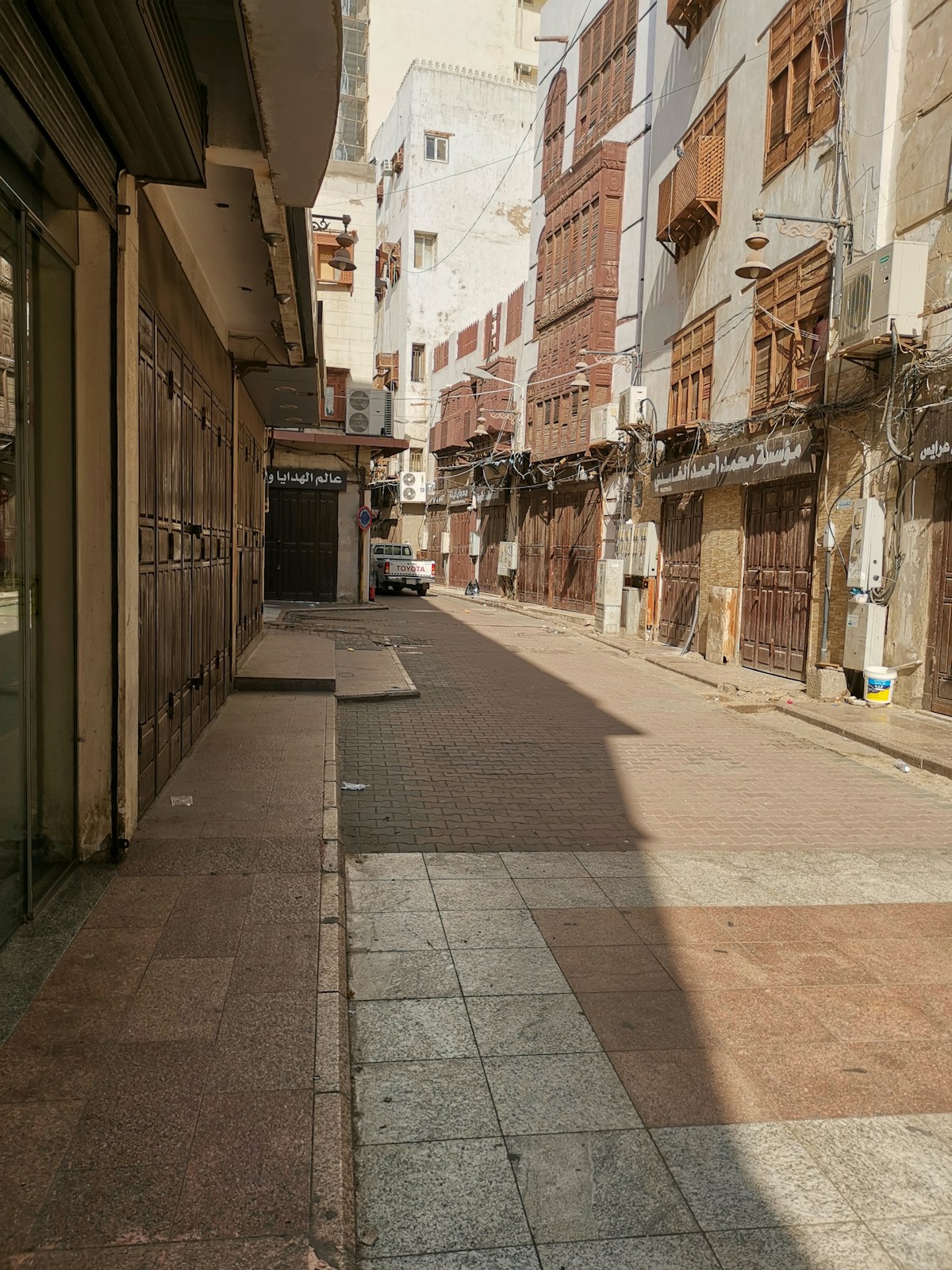
Al Balad - Arabic for “the city” or “the town” - is Jeddah’s historic heart, designated a UNESCO World Heritage Site in 2014. It is one of the most architecturally distinctive urban areas in the Arabian Peninsula: a dense grid of coral-stone buildings, some rising six or seven storeys, their facades covered in projecting wooden screens (mashrabiya) carved with geometric and floral patterns. Many of these buildings are 200–600 years old. Some are crumbling. Some have been meticulously restored. Walking through Al Balad is to move between these two states simultaneously - which is part of what makes it compelling.
This guide covers the route, the named buildings and landmarks worth seeking out, the galleries, and the cafes where you should stop.
Getting There
Al Balad sits in south-central Jeddah, roughly 5km south of the Corniche.
By car: Google Maps navigates reliably to “Al Balad Jeddah” or the more specific “Souq Al-Alawi”. Parking is available on the periphery of the old town - the car park near Bab Makkah (the Mecca Gate) is the most convenient starting point. Do not attempt to drive into the interior lanes - they are pedestrian-only narrow alleys.
By taxi/ride-hailing: Ask Uber or Careem to drop at “Bab Makkah Al Balad Jeddah”. The location pin resolves cleanly. Return via the same apps - they can find you on the main perimeter roads.
The Architecture: What You Are Looking At
Al Balad’s buildings were constructed primarily from fossilised coral stone (حجر مرجاني) quarried from the Red Sea reef. The stone is lightweight, porous, and naturally insulating - it keeps interiors significantly cooler than concrete or brick. The technique was used continuously for roughly 1,500 years until concrete arrived in the 20th century.
The defining visual element is the mashrabiya - the projecting wooden bay windows and screen panels covering most facades. These serve a practical function: they allow airflow and natural light into interiors while blocking direct solar heat and maintaining privacy. They were made by specialist craftsmen (some originally from Yemen and the Levant) whose skills were passed down through family workshops. Most working mashrabiya craftsmen in Jeddah today learned from a handful of surviving masters.
The typical Al Balad tower house (known locally as a roshan building, after the roshan - the projecting screen element) has a ground-floor commercial space opening onto the street, with residential floors above and a roof terrace. The buildings share walls; internal courtyards manage ventilation. Walking through the main alleys, look up - the upper floors and rooftop extensions are where the most elaborate carved work appears.
The Walking Route
This route covers the core of Al Balad in 2–3 hours at a moderate pace. Start at Bab Makkah and end at the northern edge near the old Jeddah corniche.
1. Bab Makkah (Mecca Gate) - Starting Point
Bab Makkah is the historic eastern gate of Old Jeddah - historically the point through which pilgrims entered and exited the city on the road to Mecca. The gate itself is a 20th-century reconstruction, but the area around it retains some of the oldest commercial buildings in the city. The morning market around Bab Makkah sells spices, herbs, and traditional goods and opens early (around 7am).
2. Souq Al-Alawi
Walking west from Bab Makkah, you reach the main commercial street of Al Balad. Souq Al-Alawi is a long, partially covered market street with shops selling textiles, incense (oud and bukhoor), traditional medicines, and gold. The street-level commerce here has operated continuously for several centuries - the building layouts above the shops are original, even where the shop fronts have been modernised. Walk the full length of the souq slowly, looking at the upper floors rather than the ground-level stalls.
Note: Many souq vendors speak Arabic only. Non-Arabic speakers will do fine for purchases (prices are indicated or negotiated by pointing and calculator) but deeper conversations require a translation app.
3. Naseef House (Beit Naseef)
One of Al Balad’s most important historic buildings, Naseef House was the largest private residence in Jeddah in the 19th century. The Al-Naseef family, prominent Jeddawi merchants, built and occupied it for generations. King Abdulaziz is said to have stayed here after entering Jeddah in 1925. The building is now managed as a cultural site - entry is typically SAR 20 as of 2026–40 per person. Guided tours in both Arabic and English run periodically.
The interior is restored and shows typical Hejazi domestic architecture: courtyard, carved plasterwork, stained glass, and an imposing wooden staircase. The building also contains one of Al Balad’s famous old trees - a niim tree (Azadirachta indica) that is said to be over 200 years old, growing in the courtyard. Visiting during morning hours means better natural light inside.
Location: Near the centre of Al Balad, accessible from Souq Al-Alawi. Look for the signposted entrance.
4. The Sharbatly Building
A short walk northwest from Naseef House, the Sharbatly Building (also written Sharbatli) is one of the best-preserved examples of a Hejazi tower house open to the street. Its mashrabiya work is unusually intact - several full roshan projections survive in good condition. The building has housed various cultural programmes and pop-up gallery spaces during Jeddah Season and Art Week events. Check current use before visiting; it may be a cultural venue, a cafe, or an active restoration project depending on when you arrive.
5. Al-Shafi Mosque
One of Al Balad’s most photographed landmarks, Al-Shafi Mosque (المسجد الشافعي) is a historic mosque with a distinctive minaret visible from most of the old town. Non-Muslims may not enter, but the exterior - especially the minaret base - is worth examining up close. The mosque is on the main walking route through Al Balad’s northern section and is usually encountered naturally while walking.
6. Bin Laden House (Bayt Bin Laden)
The former family house of the Bin Laden family, now considered part of the historic record of Jeddah’s merchant class. The building is accessible from the street and notable as an example of a well-maintained multi-generational family compound. Not an official tourist site, but visible from the street and included in most guided walking tours.
7. Al Balad Art District (Northern Section)
The northern part of Al Balad, especially around Hara Al-Andalus and the alleys connecting to the old Jeddah port area, has become an unofficial arts district over the past five years. Several galleries and creative spaces operate here:
Hayy:MEET Gallery (حي:ميت): A contemporary art and community space operating out of a restored coral-stone building. Shows emerging Saudi artists alongside regional and international work. Open hours vary - typically afternoons and evenings. Worth checking their Instagram for current exhibitions.
Gallery 21 (جاليري 21): One of the longer-established contemporary art galleries in Jeddah, located within the Al Balad area. Shows established and emerging regional artists. Entry is typically free for exhibitions. Check current programme.
Streetart / murals: Since Jeddah Season began in 2020, the Municipality has commissioned large murals on several building facades in Al Balad. These are woven into the alleys rather than announced - you encounter them while walking. The most significant are in the western alleys near the old fishing port area.
Cafes and Rest Stops
Al Balad has developed a good cafe scene, concentrated in the restored buildings and the northern arts district.
Bayt Bu Khamsin: Probably the most atmospheric cafe in Al Balad - set inside a restored traditional house with an internal courtyard. Arabic coffee, dates, traditional Hejazi sweets. Open morning to late evening. SAR 20–50 for coffee and snacks. The interior is the point: sit inside, not at street tables. Located near the Naseef House area.
Maak Cafe (معك): A popular local specialty coffee shop operating out of a restored shopfront. Saudi specialty roasts, pour-overs, and cold brew. SAR 18–30 per drink. Morning and evening crowd. Gets busy after 7pm.
Harah Bakery: A small traditional bakery selling samboosa, lahoh (a spongy flatbread), and sesame bread from early morning. Not a sit-down cafe - buy and eat while walking. SAR 5–15 for items. One of the few operations that opens from 7am.
Al Balad Rooftop (Al-Naseef House): During some event periods, the roof of Naseef House or adjacent buildings opens as a viewing platform with refreshments. Check locally when you arrive - not a permanent fixture.
Guided Tours
If you prefer structure, guided walking tours of Al Balad typically run SAR 80–180 per person and cover 2–3 hours. Most operate in the morning (9am) or evening (5–7pm). Operators active in Al Balad include:
- Jeddah Walking Tours: Listed on GetYourGuide and Viator. Small groups (max 8). SAR 120–150 per person. Guides speak English and Arabic.
- Saudi Experiences: Run by a Jeddah-based cultural operator. SAR 180 per person for a private guide, minimum 2 persons. More flexible on route and timing.
- Jeddah Heritage Tours: Budget option at SAR 80 per person, larger groups. Listed on the Jeddah Municipality heritage programme - check the Visit Jeddah website for current offerings.
For current tour listings and availability, see our Jeddah things to do page.
UNESCO Heritage Context
Al Balad was inscribed on the UNESCO World Heritage List in 2014, under criteria (ii), (iii), and (vi) - for its role in Islamic pilgrimage routes (as the historic landing point for pilgrims arriving by sea), its outstanding example of Hejazi mercantile architecture, and its cultural associations with the spread of Islam.
The inscribed area covers approximately 13 hectares and includes around 650 buildings classified as historic. Of these, UNESCO estimates roughly 150 are at immediate risk of collapse from neglect, structural failure, or flood damage (Al Balad has experienced several significant flooding events). The Saudi Heritage Commission has active restoration programmes running on multiple buildings - you will see scaffolding and restoration work on some of the major sites.
The tension between conservation and commercial development is visible in Al Balad: some restored buildings are now hotels or upscale cafes, while adjacent structures remain in serious disrepair. The overall condition is improving, particularly in the northern arts district, but deterioration in the southern sections continues.
Search hotels in Jeddah on Booking.com
Practical Notes
- Wear comfortable shoes. The alleys have uneven stone surfaces and you will walk 2–5km depending on how much you explore.
- Water: Bring water, especially May–October. Shade is limited in the wider alleys.
- Best light for photography: Golden hour (30–45 minutes after sunrise, 30–45 minutes before sunset) produces the best light on the coral-stone facades. The warm-toned stone photographs very differently in flat midday light.
- Respect for residents: Parts of Al Balad are still inhabited. Some alleys are private residential areas - follow cues if a space seems domestic rather than public.
- Ramadan: Al Balad has a particularly good atmosphere during Ramadan evenings, when the district fills with families after Iftar. Some cafes and galleries adjust their hours significantly.