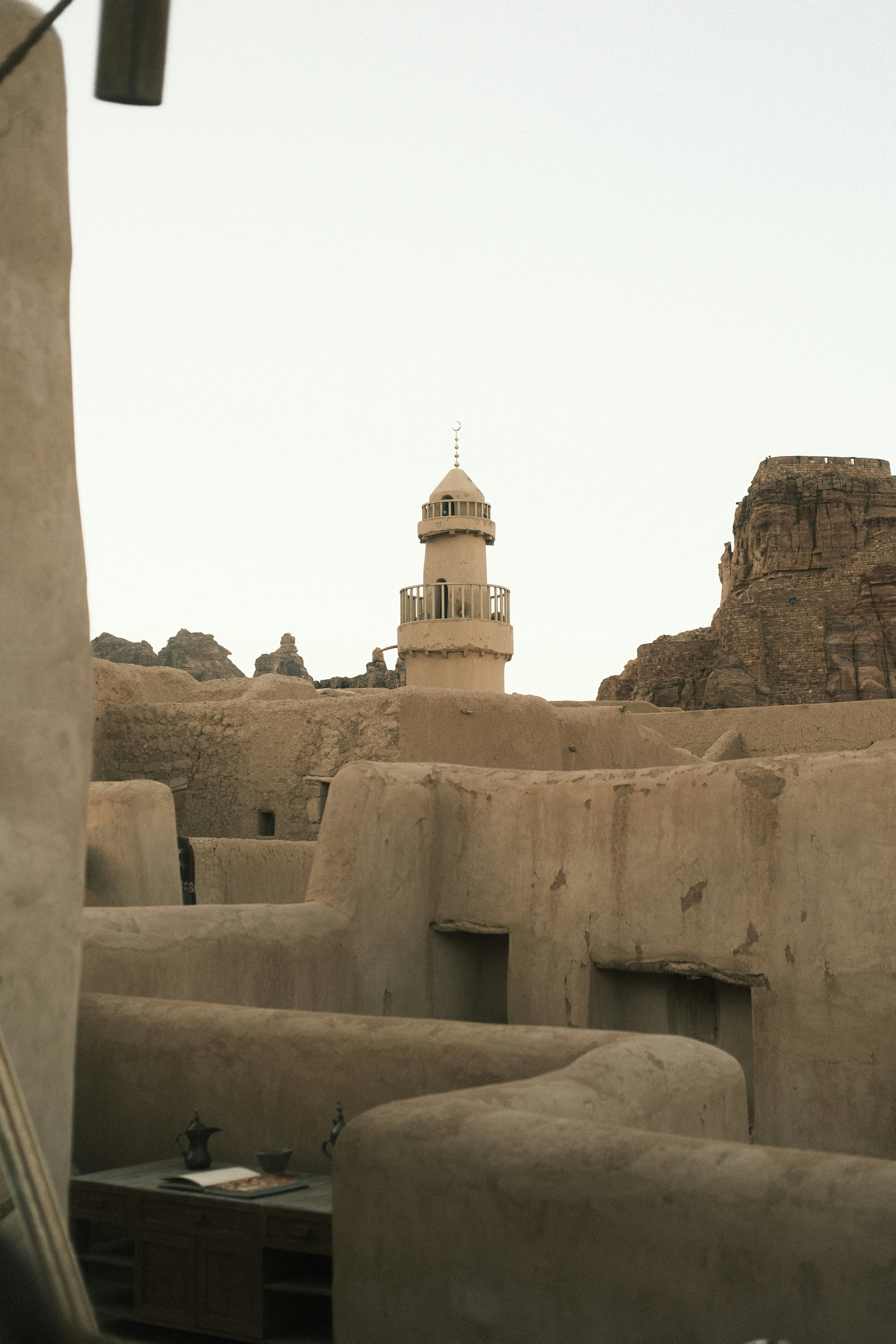
AlUla Old Town is a ghost city in the most literal sense: a mud-brick settlement of approximately 900 structures, entirely evacuated and preserved in place when the modern town was built nearby. The residents moved out incrementally through the 1980s, leaving behind a tightly packed urban grid that had been continuously inhabited for at least 900 years — some accounts suggest occupation dating to the 12th century CE, built over even earlier foundations connected to the ancient kingdoms of Dadan and Lihyan.
Walking through the old town is one of the most distinctive urban experiences in Saudi Arabia. The alleys are narrow enough that neighbours could lean out of opposing windows and shake hands; the thick mud-brick walls create a temperature differential of 5–8°C compared to the open sun outside; and the viewpoint terrace above the settlement looks down on what appears, from above, like a compressed medieval city frozen mid-life.
Entry Fees and What’s Included
Outer viewing (free): The terrace viewpoint above the old town’s western edge, approached via a short walkway from the car park, is accessible without charge. From here you can look down over the entire settlement and across to the sandstone cliffs that frame the AlUla valley.
Walking circuit (ticketed): Entry to the interior alleyways, the old mosque, and the former souk area costs approximately SAR 25–45 per person as of 2026 for the standalone circuit ticket. A bundled Heritage Experience ticket covering multiple sites (Old Town, Hegra, Dadan, Jabal Ikmah) is also available at approximately SAR 95 per adult — this represents better value if you plan to visit more than one site. Book through experiencealula.com or at the small welcome point beside the main entrance gate. The ticket includes access to the self-guided audio trail (available in Arabic and English on a dedicated app).
Guided walking tour: Approximately SAR 120–180 per person (as of 2026) for a 90-minute guided tour with a licensed AlUla heritage guide. Guides provide context on specific family houses, the mosque’s history, the agricultural terraces around the perimeter, and the process of the gradual evacuation. Private guided tours run approximately SAR 400–600 for up to 4 people.
Children under 12 enter free with a ticketed adult.
Opening Hours
- October to April: Daily 08:00–20:00; evening visits (after 17:00) are popular for the warm light on the mud-brick walls
- May to September: Morning hours only (07:30–11:00) are recommended due to heat; the site technically remains open until 17:00 but afternoon visits are not advisable
- Ramadan: Modified hours apply; check experiencealula.com for the current season
The Walking Circuit: What You’ll See
The Alleyway Grid
The old town’s 900-odd structures are arranged along a network of alleys that divide into functional zones — residential quarters, the old market street, the mosque district, and agricultural stores near the perimeter. The construction style is uniform: mud brick formed from local clay, with timber palm-trunk lintels over doorways and window openings. The structures rise to between two and four storeys, and the density means that very little direct sunlight reaches the alley floors.
The Royal Commission for AlUla has carried out stabilisation works on several sections of the most deteriorated structures. Some rooflines are reinforced with modern supports; the majority of the townscape is left in its evacuated state, meaning partial collapses, eroded walls, and the accumulated dust of 40 years of vacancy are all visible.
The Central Mosque
The Friday mosque sits roughly at the geographic centre of the settlement. Its minaret — the most visible element from the viewpoint terrace — is a distinctive square tower typical of Hejazi vernacular architecture, capped with a small open balcony. The mosque is not in active use but has been partially restored for visitor access; the interior prayer hall and the minaret staircase are viewable. Guides note the directional alignment of the mihrab (prayer niche), which points toward Mecca, as a navigational reference in the otherwise disorientating alley network.
The Old Souk Street
A single wider street near the eastern edge of the settlement served as the commercial zone. This is identifiable by the slightly larger ground-floor openings in the facades — former shop fronts that would have sold grain, dried goods, and handicrafts. The street connects directly to the outer gate through which trade goods entered the town from the farms in the surrounding palm oasis.
The AlUla Palm Oasis
The edges of the old town are surrounded by a working palm oasis that has been continuously farmed for centuries. Date palms, citrus, and vegetable cultivation continue along irrigation channels that follow the same routes as the ancient falaj (underground water channels) that originally made settlement in this valley possible. Several guided tours include a short walk through the oasis after the old town circuit.
The Viewpoint Terrace
The terrace above the old town’s western edge is accessed via a short climb (approximately 60 steps) from the car park. It provides the clearest overview of the settlement’s layout and the best context for understanding how densely packed the old town is relative to the surrounding valley. Sunset from this terrace, with the light turning the mud brick amber, is one of the most photographed scenes in AlUla.
History of AlUla Old Town
AlUla Old Town sits in Wadi Al-Qura — the Valley of Villages — a fertile corridor that was a significant waypoint on ancient trade routes connecting Yemen with the Levant. The settlement traces back at least to the 12th–13th century CE, built over even earlier foundations connected to the ancient kingdoms of Dadan and Lihyan that controlled this valley for centuries before the Islamic era.
At its peak, the town comprised around 900 houses, several mosques, a citadel, and a market district. The settlement was structured around water management: the valley floor has a reliable underground water table, and the town was designed to channel, store, and distribute irrigation water to the palm groves that formed the agricultural base. Many of the narrow alleyways double as water channels — a detail that becomes clear when examining the stone-flagged lower paths.
Different tribal groups occupied distinct residential quarters, each with shared courtyards creating community space within neighbourhoods. The gradual evacuation happened through the 1980s as residents relocated to the adjacent modern settlement with its electricity connections and vehicle-accessible roads. By around 1985, the old town was essentially empty.
The Restoration Project
The Royal Commission for AlUla (RCU), established in 2017, identified Old Town restoration as a priority. The conservation philosophy is stabilise-first: reinforcing existing structures, using traditional materials (mud, straw, local sandstone) wherever possible, and carrying out extensive archaeological documentation before any work begins.
As of 2026, the main alleyway circuit, the mosque, the souk street, and the viewpoint terrace are accessible and well-maintained. Other sections remain in various states of stabilisation — visitors should expect restoration barriers in some areas and follow site markings, as some structures remain unstable. The AlUla Heritage Museum (near the site entrance) presents documentation of the construction methods and archaeological findings.
The Citadel (Musa’ab bin Umayr Castle)
Above the settlement on the ridge sits the old town’s citadel, providing defensive oversight of the valley below. The structure dates in its current form to the Ottoman period, though the site had earlier defensive works going back to the pre-Islamic era. The climb to the citadel is worth it for the view across the palm groves and old town rooftops. Contemporary art installations — murals and commissions by visiting artists — appear on some structures near the citadel and old town perimeter, particularly during festival season.
Tour Operators and Prices
- AlUla Experiences (Royal Commission): Self-guided circuit ticket approximately SAR 25–45/person; guided tours from approximately SAR 120/person. Book at experiencealula.com.
- GetYourGuide operators: Combined AlUla heritage tours covering the Old Town, the oasis walk, and a valley overview for approximately SAR 130–200/person with hotel pickup.
- Private heritage walks: Multiple licensed guides offer private Old Town tours (90–120 minutes) from approximately SAR 400–600 for up to 4 people. These are particularly useful for architecture and history enthusiasts who want detailed commentary on specific buildings.
Most visitors pair the old town with a half-day combining Dadan and Elephant Rock — the three sites form a logical itinerary across AlUla’s different heritage layers: ancient kingdom (Dadan), Islamic-era settlement (Old Town), and natural landscape (Elephant Rock).
Getting to AlUla Old Town
AlUla Old Town is approximately 2km from the centre of modern AlUla city — essentially adjacent to the town centre.
From AlUla city centre (2km, 5 minutes)
Walking from the modern town to the old town entrance takes approximately 20–25 minutes along a paved path that follows the oasis edge. This walk is pleasant in the early morning but uncomfortable in midday heat. By taxi (Careem, InDrive): approximately SAR 10–15.
From AlUla Regional Airport (ULH) (~13km, 15 minutes)
A straightforward drive or taxi directly to the old town car park. Taxi from airport: approximately SAR 40–60.
From Medina (~380km, approximately 3.5–4 hours by road)
Highway 15 (Al Hijaz Road) runs directly north from Medina to AlUla. The old town is clearly signposted as you enter the modern town. Alternatively: fly Medina (MED) to AlUla (ULH) — approximately 1 hour, return fares from approximately SAR 250–400 as of 2026.
From Riyadh (~1,100km)
Fly Riyadh (RUH) to AlUla (ULH) — approximately 1 hour 45 minutes. Flynas, flyadeal, and Saudi Airlines operate daily direct services. Return fares from approximately SAR 300–600.
From Jeddah (~700km)
Fly Jeddah (JED) to AlUla (ULH) — approximately 1 hour 15 minutes, from approximately SAR 280–500 return.
Photography Notes
The old town is exceptionally photogenic at two moments in the day:
Early morning (07:30–09:00): Slanted light filters through the alley openings and creates strong horizontal shadows across the mud-brick surfaces. The town is generally quiet at this hour.
Late afternoon/sunset (16:30–18:00, October–February): The terrace viewpoint catches direct golden-hour light that turns the mud brick deep amber. The mosque minaret is particularly striking with the setting sun behind the sandstone cliffs.
Inside the alleys: Bring a wide-angle lens (16–24mm equivalent). The narrow alleys are too cramped for standard focal lengths at many angles, and the contrast between lit wall surfaces and shaded alley floors rewards exposure bracketing.
Practical Information
- Dress code: The old town includes a mosque and is treated as a cultural heritage site. Modest dress — covered shoulders and knees — is expected and appreciated.
- Footwear: Flat shoes with a grip sole are recommended. Some alley sections have uneven compacted earth or loose stone.
- Water: Bring at least 1 litre per person. No vendors inside the old town circuit; a café operates adjacent to the entrance gate.
- Accessibility: The viewpoint terrace and the main alley circuit are broadly accessible for able-bodied visitors. The alleyways involve some uneven surfaces and are not suitable for wheelchairs or pushchairs.
- Audio guide: A free app (AlUla Smart Guide) provides an audio commentary keyed to QR codes at numbered stops inside the circuit. Download it before arrival as connectivity inside the dense building cluster can be intermittent.
Best Season
October to February is optimal. Morning temperatures of 14–20°C make walking through the shaded alleys and climbing the viewpoint steps comfortable, and the low-angle winter sun produces the best light for photography.
The old town visits pair naturally with the broader Winter at Tantora festival calendar. During festival season, occasional evening events — music performances, storytelling sessions — are held in the old town square and announced via experiencealula.com.