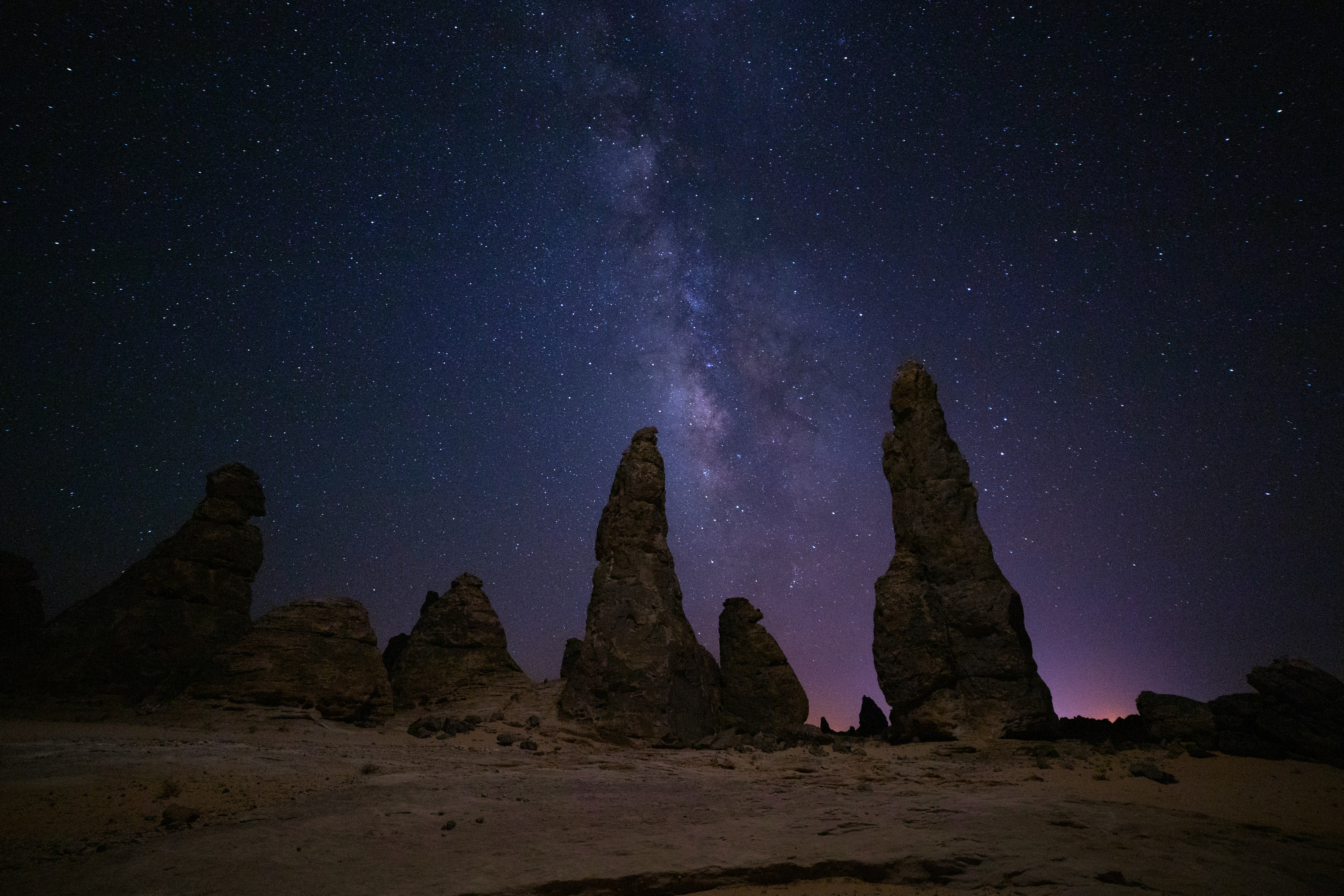
AlUla is one of the most spectacular destinations in Saudi Arabia, and its range of experiences extends well beyond the archaeological sites that dominate most guides. A sandstone canyon stretching more than 200 kilometres through northwest Arabia — hot air balloons float over it at dawn, Milky Way astronomers set up telescopes in it at midnight, and international art installations appear among the rocks every two years. These are all the activities worth building your trip around, from the free and self-guided to the bucket-list bookable.
Free and Self-Guided Activities
Not everything in AlUla requires a booking. These sites and experiences are accessible independently:
Elephant Rock (Jabal AlFil): Free entry, open sunrise to 11pm. The 52-metre sandstone monolith is 11km from the city centre on a paved road — no 4WD needed. Come in the 90 minutes before sunset when the rock turns amber and deep red. An outdoor café operates in season (SAR 20–45 for coffee and snacks). Jeep sunset tours that bundle Elephant Rock with a desert drive cost approximately SAR 150–250 per person if you’d rather not drive.
AlUla Old Town: Free entry. The 900-year-old mud-brick settlement at the canyon entrance can be explored on a self-guided audio tour via the AlUla app. Evening visits work well during the festival season when the site is lit after dark. A resident guide (SAR 80–120 for 90 minutes) adds considerable depth but isn’t required.
Maraya Concert Hall exterior: The world’s largest mirrored building is a photography stop included in most afternoon tours. Free to visit the exterior year-round; the desert vanishing effect is strongest in the two hours before sunset. Concerts require tickets (SAR 350–1,500 depending on the performer, October–March only).
Valley drives: With a rental car you can explore the palm groves, the Hijaz Railway ruins near Hegra, and several viewpoints along the canyon rim independently. The landscape itself is a destination.
Hegra: The Ancient Nabataean City
Hegra is AlUla’s UNESCO World Heritage Site — over 111 rock-cut Nabataean tombs, some 22 metres high, carved directly into the sandstone outcrops. It’s the most significant individual attraction in the region and the one activity that requires a pre-booked guided tour (independent entry is not permitted).
Tickets from approximately SAR 95 for a standard group tour to SAR 350+ for private tours as of 2026. Book through the Experience AlUla platform or GetYourGuide. Allow 3–4 hours at minimum. Morning light is best on the eastern facades.
For a full breakdown of Hegra tour formats and booking logistics — including which package to choose for your itinerary — see Hegra Guided Tours: How to Book.
Hot Air Balloon Flights
Balloon flights over AlUla are one of the region’s signature experiences. At dawn, passengers float above the canyon floor at altitudes between 200 and 500 metres, looking down on the rock formations, the old caravan road, and the patchwork of palm groves and date farms in the valley below.
Flights operate primarily during the Winter at Tantora festival season (December to March) when temperatures and wind conditions are most suitable. Prices start at approximately SAR 750 per person and rise to SAR 1,200 or more for premium sunrise departures as of 2026. Flights last approximately 45 to 60 minutes and are operated under CAA-licensed conditions.
Book through Experience AlUla or reputable tour operators like Arabian Balloon or Desert & Beyond. Availability is genuinely limited - popular dates sell out weeks in advance during the festival season. A balloon flight requires a pre-dawn departure (typically 5am to 5:30am) and is weather-dependent, with refund or rebooking policies in place for cancellations.
Dadan Archaeological Site
Dadan predates Hegra by several centuries. It was the capital of the Dadanite and Lihyanite kingdoms between roughly the seventh and second centuries BCE - civilizations that controlled the Arabian incense trade routes and whose cultural output is only beginning to be fully understood.
The site features carved tombs set into a sheer sandstone cliff, accessible via a walkway at the base. A staircase leads to the Lion Tombs, a row of carved lion figures that once guarded the burial chambers above. Visits require a licensed guide; tickets and guide arrangements can be made through Experience AlUla. Entry costs approximately SAR 80 to 120 per person as of 2026. Allow two hours.
Jabal Ikmah Rock Art
Jabal Ikmah is one of the largest concentrations of ancient rock inscriptions and petroglyphs in Arabia. The site contains thousands of carvings spread across a narrow canyon: animal figures, human forms, palm trees, hunting scenes, and inscriptions in ancient south Arabian, Dadanitic, Lihyanite, Nabataean, and Greek scripts.
Visiting without a licensed guide is not permitted. Tour operators in AlUla offer half-day Jabal Ikmah tours for approximately SAR 150 to 250 per person. Most tours combine the site with Dadan for a morning archaeology programme. The canyon is shaded and relatively cool even in warmer months, making it a practical choice for visitors who arrive outside the peak season.
AlUla Old Town
The AlUla Old Town is a 900-year-old mud-brick settlement, abandoned in the 1980s as residents moved to the modern city. Around 400 connected houses and a mosque are preserved on a rocky promontory at the canyon entrance. The covered market lanes, rooftop terraces, and narrow passages give a vivid sense of what caravan trade life looked like in this valley.
Entry is free. A self-guided audio tour is available via the AlUla app. Guided tours add context on the district’s defensive design and the families who lived there until a generation ago. Allow one to two hours. Evening visits are increasingly common as the site is lit after dark during the festival season.
Maraya Concert Hall
Maraya is the world’s largest mirrored building, a 9,740-square-metre structure clad entirely in reflective glass that vanishes into the desert landscape when the light is right. It was built for the Winter at Tantora festival and has hosted international performers including Andrea Bocelli and Lionel Richie.
Concerts run from December to March. Tickets range from approximately SAR 350 for general admission to SAR 1,500 or more for premium seating as of 2026, depending on the performer. Even without a concert, the structure is a 25-minute drive from AlUla city and frequently included in late-afternoon jeep tours as a sunset photography stop.
Desert X AlUla: Art in the Landscape
Desert X AlUla is a recurring large-scale public art exhibition that places major international works directly in the AlUla landscape. Pieces are installed at canyon viewpoints, near rock formations, and in the palm groves. The programme runs every two years (most recently 2022 and 2024) and typically overlaps with the Winter at Tantora season.
Entry to Desert X AlUla is free. A map of installations is available at the AlUla Visitor Centre and through the Experience AlUla app. Walking between installations is not practical given the scale; most visitors rent a car or join a guided art tour covering five to eight works in a half-day.
Stargazing and Night Desert Camps
AlUla’s position in a remote canyon, far from major city light pollution, produces some of the best dark skies in the Arabian Peninsula. On clear nights, the Milky Way is visible without equipment. Several operators offer dedicated stargazing experiences combined with Bedouin-style camp dinners.
Packages typically cost SAR 300 to 600 per person and include transport from AlUla city, dinner, telescope access with an astronomer, and return transfer. Some operators offer overnight desert camps with private tents at SAR 800 to 1,500 per person as of 2026. Desert & Beyond and Experience AlUla list verified operators on their platforms.
Day Trips From AlUla
The day trip options from AlUla extend the itinerary considerably. Tayma, an ancient oasis city with a 2,500-year history, sits 265 kilometres northwest via Route 375 - approximately a three-hour drive. The Hejaz Railway ruins and Mada’in Salih railway station (now restored as a heritage site) are accessible near Hegra itself.
For those driving the full northwest circuit, Tabuk is four hours north on the highway and connects to Wadi Disah and the NEOM coastal areas. These work best as two-night extensions rather than single-day returns.
Practical Notes for AlUla Activities
Getting there: AlUla Regional Airport (IATA: ULH) receives flights from Riyadh (~1h20m) and Jeddah (~1h) operated by Saudia, flyadeal, and flynas. Book 4–6 weeks ahead for better fares. Driving from Riyadh is over 1,100km — not a practical day trip.
Getting around: AlUla has no public transport in the archaeological zone. Taxis run from the city centre. Rental cars give maximum flexibility for the self-guided sites (Elephant Rock, valley drives, Old Town). Hegra and Dadan require a licensed guide regardless of your transport.
Booking priority: Hot air balloon slots and Hegra tours fill first, especially during the Winter at Tantora festival (December–March). Book these before anything else. Stargazing camps and jeep tours can usually be arranged within a day or two.
Seasonal note: Outdoor activities are best October–March. Hot air balloons only run in this window. Stargazing is year-round but best in winter when skies are clearest. June–September temperatures reach 35–44°C and most outdoor experiences limit morning operating hours.
Browse AlUla tours on GetYourGuide for current availability. Get a Saudi eSIM before arrival — coverage in the main heritage areas is good, but patchy on valley approach roads. Add travel insurance for cancellation cover if booking peak-season activities in advance.
See Also
- Hegra Guided Tours — full booking guide for the Hegra UNESCO site
- Best Tours in AlUla — comparison guide to choose the right tour format
- AlUla 3-Day Itinerary — structured day-by-day plan
- Day Trips from AlUla — Tayma, Tabuk, and the northwest circuit
- Winter at Tantora — festival season programming December–March