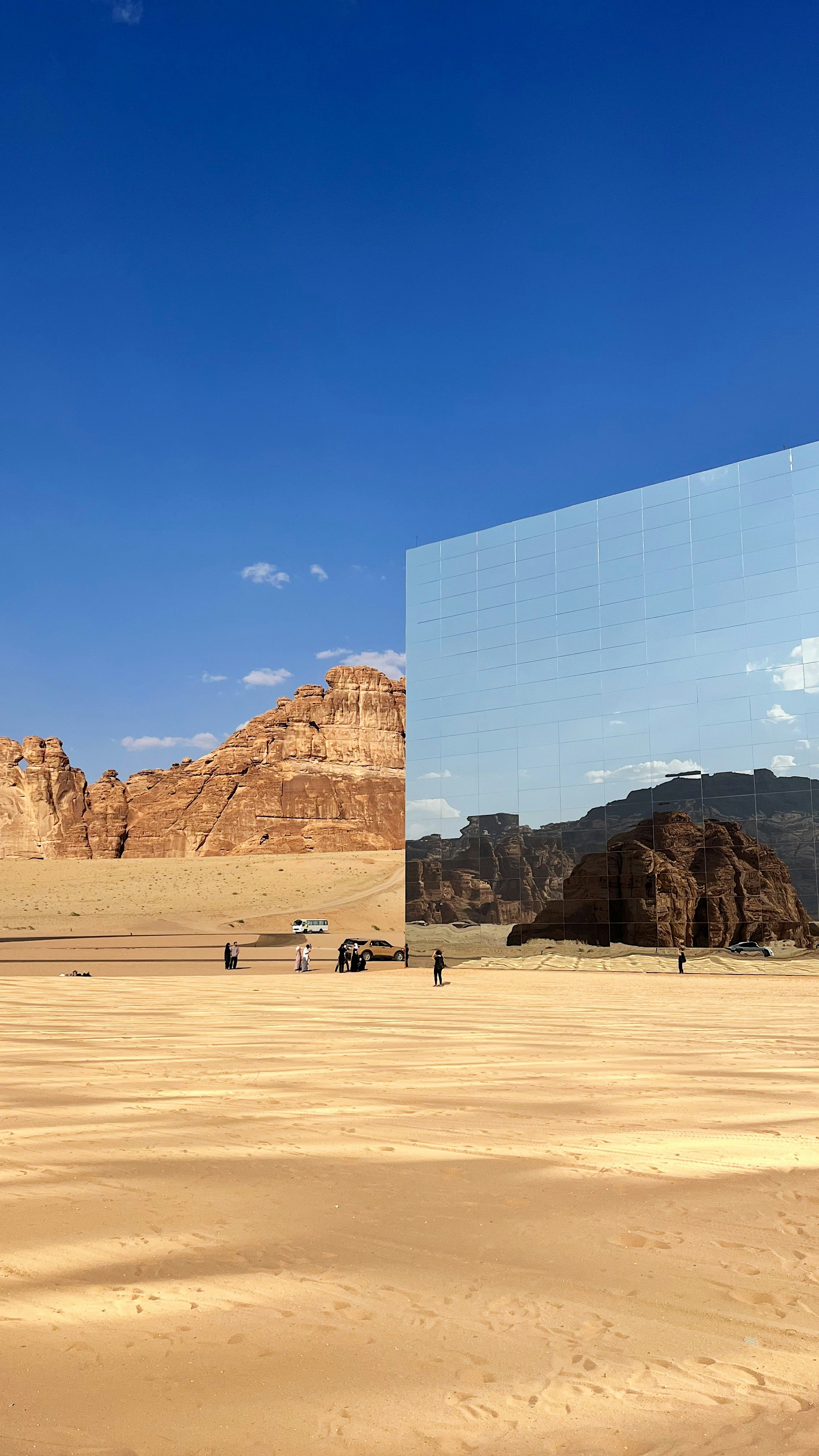
Maraya holds a Guinness World Record as the largest mirrored building in the world. The structure — 9,740 square metres of mirror-clad façade — sits in the Ashar Valley approximately 12km from AlUla city, surrounded entirely by sandstone desert. When you approach it for the first time, the building appears to dissolve into the landscape: the cliffs and sky reflect so perfectly in the glass panels that locating the building’s edges requires a moment of adjustment.
The name translates from Arabic as “mirrors” or “reflections.” It was commissioned by the Royal Commission for AlUla and completed in 2019. Since then it has hosted international concerts (Andrea Bocelli, Lionel Richie), opera performances, business conferences, and formal dinners. It represents the most visible statement of AlUla’s transformation from an archaeological heritage destination into a year-round cultural events venue.
What Maraya Is (and Is Not)
Maraya is a functioning events venue, not a museum or tourist attraction open for general visits. The interior — which seats approximately 500 for concerts or seats up to 700 in banquet configuration — is only accessible to ticket holders during scheduled events.
There is no entrance fee for viewing the exterior. Visitors who arrive outside event times can walk around the building’s perimeter, take photographs, and view the surrounding Ashar Valley from the gentle rise behind the venue.
If you want to go inside: Monitor experiencealula.com and the Winter at Tantora festival programme for upcoming events. Ticket prices vary significantly by event type:
- Classical music concerts: approximately SAR 200–600 per person (as of 2026), depending on seating category
- Gala dinners and sunset dining events: approximately SAR 450–900 per person, typically including a set menu
- Major international headliners: SAR 500–1,200+, with premium floor and VIP options
- Festival events during Winter at Tantora: Some ticketed, some included in multi-day festival passes
Getting to Maraya
From AlUla city centre (~12km, 15 minutes)
Take Al Hijaz Road north from AlUla city and turn onto the signed Ashar Valley road. Maraya is clearly visible from the access road — the mirror building is unmistakeable against the rock backdrop. Ample free parking is available in a cleared area adjacent to the venue.
Alternatively, Careem and InDrive operate in AlUla; a one-way fare from the city centre costs approximately SAR 35–55.
From AlUla Regional Airport (ULH) (~16km, 18 minutes)
Maraya is a straightforward drive from the airport. Rental cars from AlUla airport are available from Hertz and local operators from approximately SAR 160–250 per day. Airport taxis to Maraya cost approximately SAR 50–70.
From Riyadh, Jeddah, or Medina
Flying into AlUla Regional Airport (ULH) is the standard approach:
- Riyadh (RUH → ULH): Daily direct flights on Flynas, flyadeal, and Saudi Airlines. Approximately 1 hour 45 minutes. Fares from approximately SAR 300–600 return as of 2026.
- Jeddah (JED → ULH): Daily direct flights. Approximately 1 hour 15 minutes. Fares from approximately SAR 280–500 return.
- Medina (MED → ULH): Direct flights available; approximately 1 hour. Fares from approximately SAR 250–400 return.
Photography at Maraya
The exterior of Maraya rewards careful timing. The building’s reflective surface changes dramatically as light conditions shift.
Best times to photograph:
- Dawn (06:30–08:00, October–February): The low eastern light turns the mirror panels pale gold, and the cliffs behind the building catch warm early light. The valley is usually empty at this hour.
- Golden hour before sunset (16:30–17:30, October–February): The western light directly illuminates the front face, and the reflection of the surrounding dunes and cliffs is at its most saturated. This is the most commonly photographed version of Maraya.
- Full midday: The building becomes almost invisible — the cliffs, sky, and sand reflect so uniformly that the structure nearly disappears. This is architecturally interesting but less dramatic photographically.
Position for the classic shot: Stand approximately 80–100 metres directly south of the main façade, facing north. This gives the full reflection of the Ashar Valley behind you in the mirror panels. Using a wide-angle lens captures both the building’s full width and the cliff backdrop above.
Drone flights: Permitted in AlUla with a prior permit from the Royal Commission for AlUla. Apply via experiencealula.com at least 48 hours in advance. Aerial shots from the southeast show the building’s location within the valley most clearly.
Events at Maraya
Maraya’s event calendar is concentrated in the Winter at Tantora festival season (typically December through March), when AlUla operates its full cultural programme at peak intensity. This is the primary season when the venue hosts multiple events per week.
Winter at Tantora (December–March) is the headline season. The programming includes concerts, cultural performances, dining experiences, and art installations. International artists who have performed at Maraya include Lionel Richie, Andrea Bocelli, and Mariah Carey. Ticket prices during this window range from approximately SAR 200 for general admission to SAR 1,200–2,000+ for gala dinners and premium experiences (as of 2026).
AlUla Arts Festival (January–February): Contemporary visual art and performance programmes, often linked to the Desert X AlUla biennial. Maraya frequently serves as an anchor venue during this period.
Typical event types throughout the season:
- Classical concerts with internationally recognised performers
- Arabic music concerts during major Saudi cultural festivals
- Bollywood and international entertainment events
- Corporate conferences and product launches (not open to the public)
- Gala dinners with themed décor
- Art exhibitions and film screenings
- Award ceremonies
Outside the festival season (April–November): Events are fewer and more sporadic. The venue operates primarily for private and corporate bookings. Check experiencealula.com for the current calendar and ticketing.
Getting tickets and booking:
- Book through experiencealula.com — the official platform with the widest selection of events
- Ticketmaster Saudi Arabia (ticketmaster.sa) carries major concert bookings as a secondary option
- For high-demand international headliners, book at least four to six weeks in advance
- Some events sell out within 24–48 hours of going on sale during peak Winter at Tantora season
- There is no physical box office; all booking is online
Price guide (as of 2026):
- General admission concerts: SAR 200–500
- Premium standing and reserved seating: SAR 500–1,200
- Gala dinners and special experiences: SAR 1,200–3,000 per person
- Art exhibitions (when ticketed): SAR 50–150
Combining Maraya with Other AlUla Attractions
Maraya sits in the Ashar Valley and is geographically close to Elephant Rock (Jabal AlFil), making the two an easy pairing for a single afternoon or evening:
- Maraya exterior photography: 20–40 minutes
- Drive to Elephant Rock: 8 minutes from Maraya
- Elephant Rock sunset: 60–90 minutes
Adding the AlUla Old Town walking circuit (approximately 30 minutes by road from Maraya) turns this into a full-day cultural circuit covering the city’s ancient mud-brick heritage, its most iconic natural formation, and its most striking piece of contemporary architecture — all within a 15km radius.
Most licensed AlUla day-tour operators include Maraya as a stop on wider valley circuits. GetYourGuide operators offer combined “AlUla Highlights” tours covering the valley, Elephant Rock, and a Maraya exterior visit for approximately SAR 130–200 per person.
Practical Information
- No food or drink available at the exterior outside event periods. The nearest café is approximately 15 minutes back toward AlUla city centre.
- Toilets: No public toilets at the exterior. Facilities are inside the venue for ticket holders only during events.
- Dress code: Smart-casual for event attendance; standard modest dress code applies for exterior visits (covered shoulders and knees recommended at all AlUla cultural sites).
- Accessibility: The approach from the car park is flat and unpaved sand — a short, manageable walk for most visitors. Event interiors are wheelchair accessible.
Best Season
November to February is the optimal period — aligning with the Winter at Tantora festival season, the coolest temperatures (12–24°C), and the best photography light. During this window, events at Maraya are at their most frequent and varied.
March through October: The building’s exterior is always viewable, but events are sparse and afternoon heat (regularly 35–45°C from May onward) makes outdoor photography uncomfortable. If visiting outside the festival season, target early morning for the exterior and plan your wider AlUla itinerary around morning activities.
Book AlUla Tours on GetYourGuide
Most visitors see Maraya as part of a wider AlUla valley circuit. These tours include hotel pickup from AlUla city and cover the main sites in a logical sequence. Prices are approximate as of 2026; free cancellation up to 24 hours on most bookings.
| Tour | Duration | From | What’s included |
|---|---|---|---|
| AlUla Full-Day Wonders: Hegra, Dadan, Ikmah & Elephant Rock | Full day | ~$100/person | Hegra UNESCO site, Dadan, Jabal Ikmah, Elephant Rock — licensed guide and transport |
| AlUla: Hegra, Dadan & Ikmah Highlights Tour | Half day | ~$80/person | Three of AlUla’s main heritage sites with a licensed guide |
| AlUla: Hegra Guided Tour | 3 hrs | ~$60/person | Dedicated Hegra UNESCO site tour — best for those who want depth at a single site |
Browse all AlUla tours for Maraya event tours, stargazing experiences, and jeep sunset circuits.
See Also
- Elephant Rock AlUla — the sandstone formation 10 minutes east of Maraya
- AlUla Activities Guide — full overview of things to do in the valley
- Hegra Tickets and Booking — the UNESCO Nabataean site, AlUla’s flagship heritage attraction
- AlUla City Guide — accommodation, getting around, and practical planning
- Winter at Tantora — the festival season when Maraya events are at their most frequent