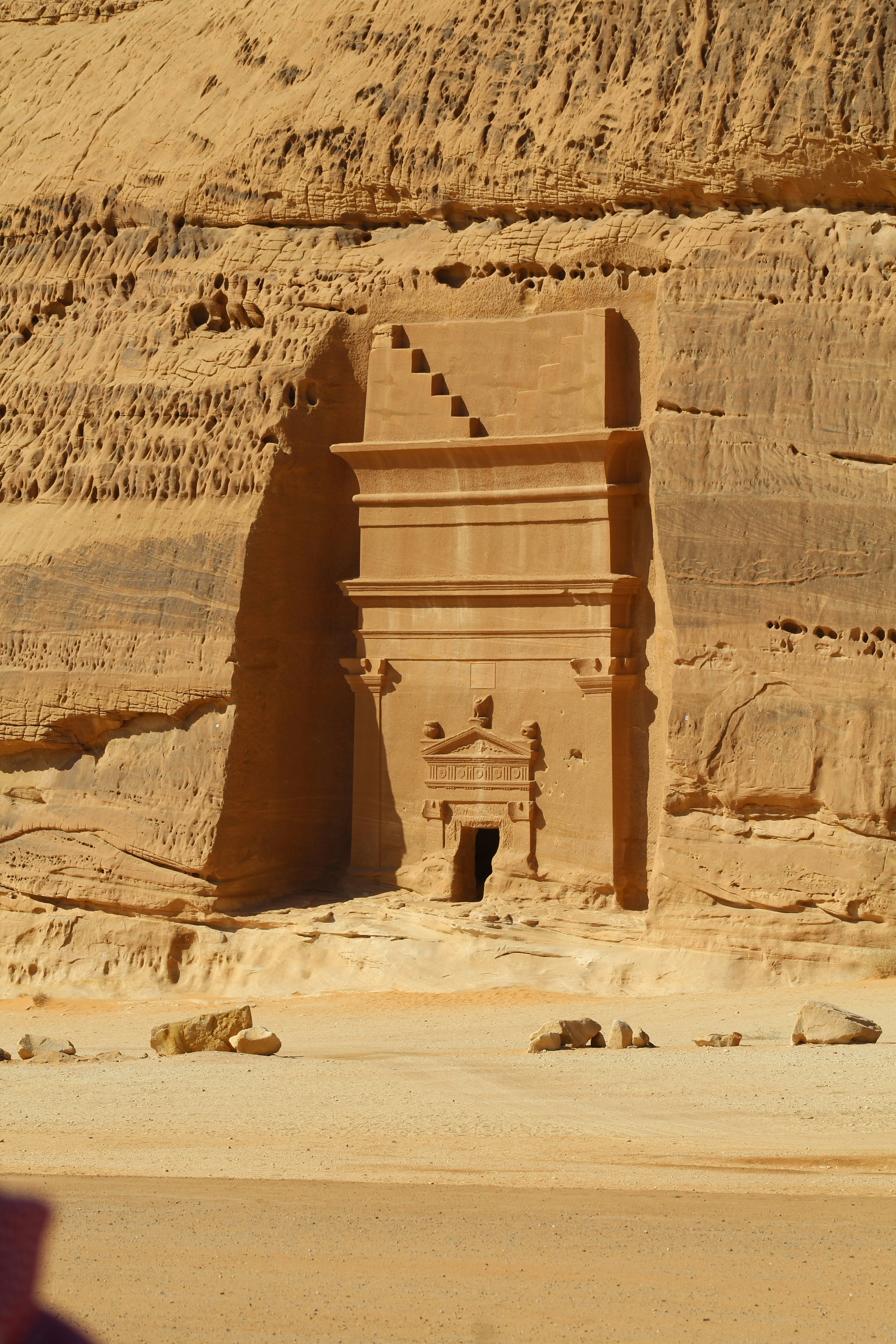
In 2020, the same organisation that put contemporary art into California’s Coachella Valley brought its format to Saudi Arabia. Desert X AlUla has since become the most significant recurring contemporary art event in the Middle East — not because of its budget, though the budgets are considerable, but because of its setting. There is nowhere else on earth where large-scale land art installations sit among Nabataean tombs carved 2,000 years ago, below sandstone formations that have been sculpted by wind for fifty million years. The juxtapositions are extreme and they work.
What Desert X AlUla Is
Desert X is an internationally curated biennial of site-specific contemporary art that originated in the California desert in 2017. The AlUla edition launched in 2020 as a collaboration between the Royal Commission for AlUla and the Desert X organisation. It runs every two years (2020, 2022, 2024, 2026) during the cooler winter months, typically February through April.
The format: a curatorial team selects eight to twelve international and Saudi artists and commissions them to create new works specifically for the AlUla landscape. Each artwork responds to the site — its geology, its light, its history, or its social context. The works are installed across a corridor stretching from AlUla town through the Ashar Valley, Dadan, Jabal Ikmah, and out towards Hegra. Some installations sit in open desert. Some occupy ancient trade routes. A few have been positioned so that dawn or dusk lighting becomes an integral part of the work.
Past participating artists have included Lawrence Abu Hamdan, Rangi Parata, Lita Albuquerque, Manal AlDowayan, and Sherin Guirguis — a deliberately international and regionally representative roster that prevents the event from reading as either a generic Western export or a narrowly local affair.
How to Find and Access the Installations
This is where most first-time visitors need preparation. Desert X AlUla is not a concentrated gallery — the artworks are distributed across a 20 km corridor of desert, canyon, and heritage landscape. Navigation requires a plan.
Official map and app: The experiencealula.com platform publishes a downloadable installation map at the start of each edition. The AlUla Experience app includes GPS-pinned locations for each work. Download both before arriving — mobile data in the Ashar Valley and outlying desert is workable but not always reliable.
Self-guided: If you have a rental car and comfortable desert driving experience, many installations are reachable independently. Parking is signposted at major sites. Allow at least four to five hours to visit eight to ten works at a relaxed pace, plus time for photography.
Organised tours: AlUla Experience (experiencealula.com) and private operators including AlUla Tours and Dadan Experience offer guided Desert X itineraries. These typically run 4–6 hours, include transport, and a guide who provides conceptual context for each work. Prices from approximately SAR 250–400 per person as of 2026. GetYourGuide lists full-day AlUla tours that can be combined with Desert X installations for visitors who prefer a pre-arranged format. For visitors with limited time or unfamiliar with off-road navigation, this is the better option.
Guided convoy access: Some installations in restricted heritage zones — particularly works near Hegra or on protected cliff faces — are only accessible via organised convoy. These require advance booking through experiencealula.com and are often the most dramatically located pieces of the entire exhibition.
What to Expect When You Visit
Scale: Desert X installations are large. We are not talking about a sculpture you walk past — we are talking about works that reshape how you read the landscape around them. A mirrored wall that stretches 40 metres. A sound installation embedded in a canyon face. A tower that functions as a sundial referencing ancient astronomical observation. Budget more time than you think each piece needs.
Photography: This is one of the most photographed art events in the world, and for good reason. Morning light in the Ashar Valley produces a warm amber cast across the sandstone that most installations respond to powerfully. Golden hour is similarly dramatic. Midday is harsh and flat — if you are there purely for photography, plan your installation sequence around the light, not the map.
Walking and terrain: Some installations require a short desert walk across uneven ground. Wear closed shoes with ankle support. The terrain is generally not technical, but sandals and flip-flops are inadvisable. In February and March temperatures range 14–24°C during the day — layers are useful in the morning.
Crowds: Desert X AlUla is not crowded by international festival standards, but specific installations that are particularly photogenic or social-media-visible attract concentrated visitor groups in the late afternoon. If you want installations to yourself, visit weekday mornings.
Tickets and Costs
Desert X AlUla operates a mixed model:
Free access: A selection of installations in publicly accessible areas of the AlUla valley are free to visit without booking. These are typically the works in open desert or on public pathways.
Ticketed access: Installations in managed heritage zones, evening events, artist talks, and curated tours require tickets. As of recent editions, day-pass tickets for the managed corridor ranged from SAR 75–150 per person. Check experiencealula.com for 2026 pricing before your trip.
Evening events: Desert X programming includes a series of evening talks, performances, and special openings, some held at Maraya Concert Hall. These carry separate event tickets — see the Maraya Concert Hall AlUla guide for details on how to book.
Combined tickets: AlUla Experience has previously offered combined passes covering Hegra, Dadan, Jabal Ikmah, and Desert X at a discount versus individual entry. These are good value if you plan to visit multiple heritage sites. Verify availability at experiencealula.com.
Getting There from AlUla Town
Desert X installations spread from AlUla town outward — some are a 5-minute drive, others up to 40 minutes north towards Hegra.
From AlUla town centre: Take Route 375 north along the Ashar Valley. Most installations in the central corridor are signposted. The drive to the furthest northern sites (near Hegra) takes approximately 30–35 minutes without stops.
Taxi or rideshare: Uber and Careem operate in AlUla. A taxi to the main valley installations costs SAR 40–60 from town. For a full-day Desert X visit covering multiple sites, hiring a driver for the day (SAR 350–500 as of 2026) is more practical than calling rideshares between remote locations.
AlUla airport to Desert X: AlUla Regional Airport (ULH) is approximately 18 km from the town centre. Rental cars are available from the airport — Budget, Theeb, and other operators have desks. Having your own vehicle gives the most flexibility for a self-guided Desert X day.
Best Time to Visit
February and March are the optimal months — the heart of the Desert X season, with all installations active and temperatures 14–24°C during the day. This also coincides with the tail end of Winter at Tantora at Maraya, so the full breadth of AlUla programming is accessible simultaneously.
Early morning visits (08:00–10:00) mean directional desert light and small crowds. The sandstone cliffs glow amber and the installations that interact with shadow or reflection are at their most active. Many guides and photographers consider this the single best window of the day.
Avoid midday (11:00–14:00): Light is flat, temperatures are at their peak (still manageable at 20–25°C in February, but uncomfortable for a long outdoor walk), and the experience is less rewarding visually.
Combining Desert X with Other AlUla Attractions
Desert X does not exist in isolation — the entire AlUla heritage corridor surrounds it, and the artworks are in conscious dialogue with the ancient landscape. Plan at least two days in AlUla to see Desert X properly alongside:
- Hegra (Madain Salih): Saudi Arabia’s first UNESCO World Heritage Site, 22 km north of AlUla town. Nabataean rock-cut tombs at a scale that has to be seen in person. Entry approximately SAR 195 as of 2026, book at experiencealula.com.
- Dadan: The ancient capital of the Dadanite kingdom, with carved lion tombs and ongoing excavation. Entry approximately SAR 95 as of 2026.
- Jabal Ikmah: The “open-air library” of 1,500+ ancient inscriptions in Lihyanite, Dadanite, Nabataean, and other scripts. Free to enter with an AlUla Pass.
- Elephant Rock (Jabal al-Fil): The sandstone elephant formation, 11 km north of town. Free entry, illuminated at night.
- Maraya Concert Hall: 15 km north of town in the Ashar Valley — check the events calendar for any Desert X-linked performances during your visit.
A suggested two-day structure: Day 1 covers Hegra, Dadan, and Jabal Ikmah (book as a guided morning). Day 2 covers Desert X installations in the valley plus Maraya for sunset photography, with a cultural dinner in AlUla Old Town to close.
Booking and Planning Notes
- Book AlUla accommodation well in advance for the February–March peak season. Shaden Resort, Habitas AlUla, and Banyan Tree AlUla are the main options at various price points — from approximately SAR 800 to SAR 5,000 per night as of 2026. Budget guesthouses in AlUla town offer basic rooms from SAR 200–350.
- Check desertx.org and experiencealula.com for the official 2026 artist lineup and installation map. These are updated as the event approaches.
- Allow more time than you think. First-time visitors consistently underestimate both the distances between installations and the time they want to spend at each work. Four hours feels generous on paper; six hours is what most visitors actually need.