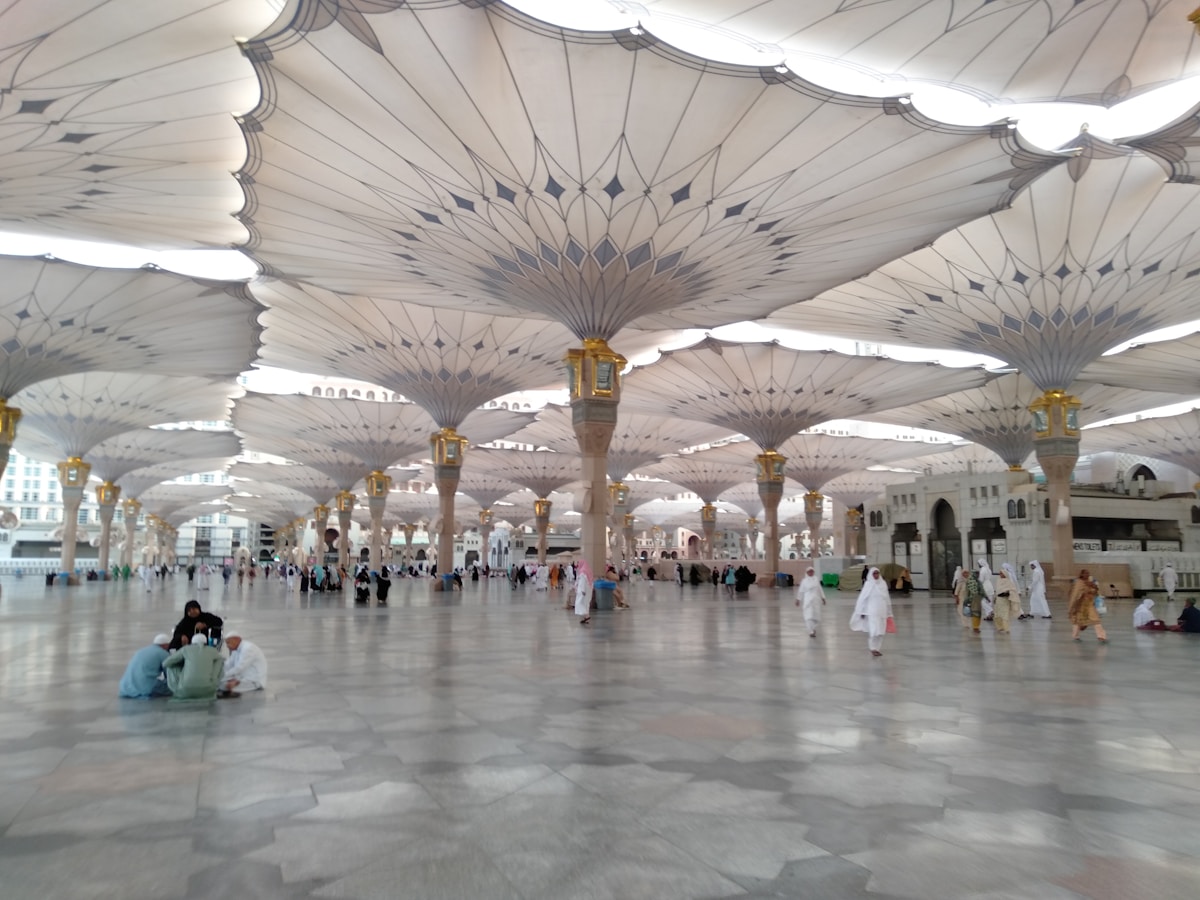
Medina — Al-Madinah Al-Munawwarah, the Illuminated City — is Islam’s second holiest city and the burial place of the Prophet Muhammad. Unlike Mecca, which is administratively closed to non-Muslims, Medina’s commercial districts are accessible to all visitors, though the inner haram zone around Masjid al-Nabawi is not. The city receives millions of pilgrims annually, and its food scene has evolved over centuries to feed a constantly rotating population from Egypt, Indonesia, Pakistan, West Africa, South Asia, and beyond. The result is a Hejazi cuisine with deeper pilgrimage-route influences than anywhere else in Saudi Arabia.
Al-Madinah Cuisine: What Makes It Distinct
Medina’s food identity rests on the same Hejazi tradition as Jeddah and Mecca — the western Arabian coastal cuisine shaped by the spice trade and pilgrimage economy — but with one distinctive signature: saleeg.
Saleeg is white rice slow-cooked in milk and chicken broth, seasoned with cardamom, cinnamon, and bay leaf, until it becomes soft and semi-liquid — closer to a thick rice porridge than to separate-grain kabsa. It is served topped with roasted chicken and accompanied by dakka, a raw tomato and green chilli salsa that provides the acidic contrast the rich rice needs. Saleeg is eaten with a spoon rather than by hand, and it is Medina’s most distinctive claim in Saudi regional cuisine. You will not find it prepared with the same intensity of milk flavour in Riyadh or the Eastern Province.
Other traditional dishes common across Medina:
Kabsa — the Saudi national dish of long-grain rice with slow-cooked lamb or chicken, spiced with black lime, cinnamon, and saffron. Every neighbourhood restaurant in Medina serves it; the quality varies from functional (adequate, cheap) to genuinely excellent at specialist restaurants.
Madfoon — spice-marinated lamb slow-cooked in a sealed container, served over rice. A feast-day preparation that appears at traditional restaurants as a premium option, often requiring advance ordering.
Margoog — a brothy stew of chicken or lamb with vegetables and torn flatbread cooked into the liquid. Economical, warming, and popular as a lunch option.
Saleeg al-laham — a variation of saleeg made with lamb stock instead of chicken. Less common than the standard version but found at traditional restaurants that take the dish seriously.
Ajwa Dates: Medina’s Most Important Food Export
No discussion of Medina food begins anywhere except dates. The city is the primary growing region for Ajwa dates — a soft, dark, wrinkle-skinned variety whose cultivation is concentrated in the Medina date groves (between approximately 1.5 and 2 million palms). Ajwa are among the most revered dates in Islamic tradition, referenced in Hadith. The flavour is distinctive: prune-like, mildly sweet, with a soft, almost fudgy texture. They are less cloyingly sweet than the Barhi or Medjool and have a more complex, slightly tannic finish.
Where to buy Ajwa dates in Medina:
The Al-Nakheel Market (date market area) near the Central Market is the best source for fresh and packaged Ajwa. Specialist shops — many operating from the same family for generations — sell multiple grades from approximately SAR 60 to SAR 200 per kilogram as of 2026, with the highest grades reserved for gift boxes. The price difference reflects harvest year, size consistency, and moisture content.
The date shops along Quba Road and near Masjid Quba offer a wider price range and are slightly less tourist-facing than the shops immediately adjacent to Masjid al-Nabawi. Arrive knowing what you want — sellers can be enthusiastic, and the tasting samples add up.
Avoid buying pre-packaged Ajwa from hotel gift shops near the mosque — the markup is significant and quality is not guaranteed.
Street Food Near Masjid al-Nabawi
The streets surrounding Masjid al-Nabawi — particularly King Faisal Road, Prince Abdul Majeed Road, and the pedestrian zones immediately north and west of the mosque — are dense with food options at all hours. Pilgrims need to eat between prayer times, and the vendors who serve them operate around the clock.
Samboosa stands open from shortly after Fajr prayer. These deep-fried triangular pastries filled with spiced minced lamb, cheese, or potato cost approximately SAR 2–3 each and are the street breakfast of choice for pilgrims who want something hot and quick. Quality varies; look for stalls with high turnover where the oil is clearly fresh.
Flatbread bakeries (khubz stalls) bake through the night and into the morning. A single round of fresh-baked khubz costs SAR 1–2 and is best eaten immediately with hummus, fuul (spiced broad beans), or a smear of date molasses. Some stalls sell flatbread stuffed and toasted — a step up from the plain round.
Falafel and fuul shops on King Faisal Road serve the Egyptian-influenced Hejazi breakfast staple. A plate of fuul medames — broad beans mashed with olive oil, cumin, and lemon — costs approximately SAR 8–15 and is filling enough to carry you through to the midday prayer.
Tea houses (chai shops) operated by South Asian communities serve strong, spiced milk tea (karak chai) in small glasses from dawn to midnight. A glass costs SAR 3–5 and these are the social hubs of the pilgrim street economy — sit with your chai and watch the city work.
Best Restaurants for Sit-Down Meals
Al-Baik — Saudi Arabia’s most beloved fast food chain, with fried chicken that has a genuinely devoted following. The Medina branches near the mosque district are among the busiest in the country. Broasted chicken with garlic sauce, a garlic roll, and a drink costs approximately SAR 20–28. Not traditional, but an honest representation of what Saudis actually eat. Queue is part of the experience.
Al Nakheel Restaurant (various locations near the Central Area) — a mid-range traditional restaurant serving saleeg, kabsa, and madfoon in a clean sit-down environment. Main dishes from approximately SAR 35–70. The saleeg here is reliably good — the milk rice arrives at proper consistency with the chicken properly crisped on top.
Restaurant row on King Faisal Road — a stretch of competing traditional Saudi restaurants where kabsa and saleeg are served communally at long tables. Most do not have formal menus in English; point at what the next table is eating and you will not go badly wrong. Expect SAR 20–45 per person for a main and water.
Al-Madina Al-Munawwara Traditional Restaurant near the hotel district serves Hejazi food at a slightly higher price point (SAR 60–110 per main) with better English-language service, making it the default option for first-time visitors who want a traditional meal without language barriers.
Pakistani and Indian restaurants along the secondary streets behind the mosque district serve South Asian halal food — biryani, karahi chicken, daal — to the large pilgrimage communities from those countries. Prices are often slightly lower than Saudi traditional restaurants (SAR 18–35 per main) and the food is very good at the better-patronised establishments.
Take a Guided Food Tour of Medina
The streets surrounding Masjid al-Nabawi have sustained a food economy for centuries, layering Hejazi saleeg and Ajwa date culture with Egyptian, Yemeni, South Asian, and Turkish food traditions brought by pilgrims who stayed. A guided food experience in Medina traces that history through the date markets, street food stalls, and traditional restaurant clusters that most visitors walk past without context. It is the most efficient way to understand why Medina’s kitchen looks the way it does — and why the saleeg served here tastes different from anything else in Saudi Arabia.
Browse Medina tours on GetYourGuide for guided city experiences and Ajwa date culture tours. The Saudi Arabia tour listing covers experiences across the full Hejaz region.
Practical Dining Tips for Medina
Meal timing follows prayer schedules. Restaurants do not typically close for each prayer, but service slows considerably. The hour immediately after Maghrib prayer (sunset) is the quietest time to sit down; the hour after Isha (late evening) is when most restaurants are at their busiest.
Restaurants near the mosque are priced for pilgrims. Meals a five-minute walk from Masjid al-Nabawi cost more than equivalent food three streets further out. Walk one or two blocks from the main pedestrian areas to find the same kabsa at 20–30% lower prices.
Women dining alone or in groups are fully accommodated in Medina. Most sit-down restaurants have family sections; smaller fast food spots are counter-service and mixed. This is a normal part of the city’s function as a pilgrimage centre.
Carry small change for street food. SAR 2–3 coins for samboosa and tea stalls are useful; many small vendors cannot break SAR 50 notes easily.
Ramadan transforms the street food scene. During the holy month, iftar (the meal breaking the fast at sunset) is a community event on the streets surrounding Masjid al-Nabawi. Vendors set up long tables of free dates, water, and soup for pilgrims. The atmosphere is unlike anything at any other time of year. If your visit coincides with Ramadan, plan to be near the mosque at Maghrib prayer time.
Where to stay: Find hotels in Medina — search accommodation across all budgets.