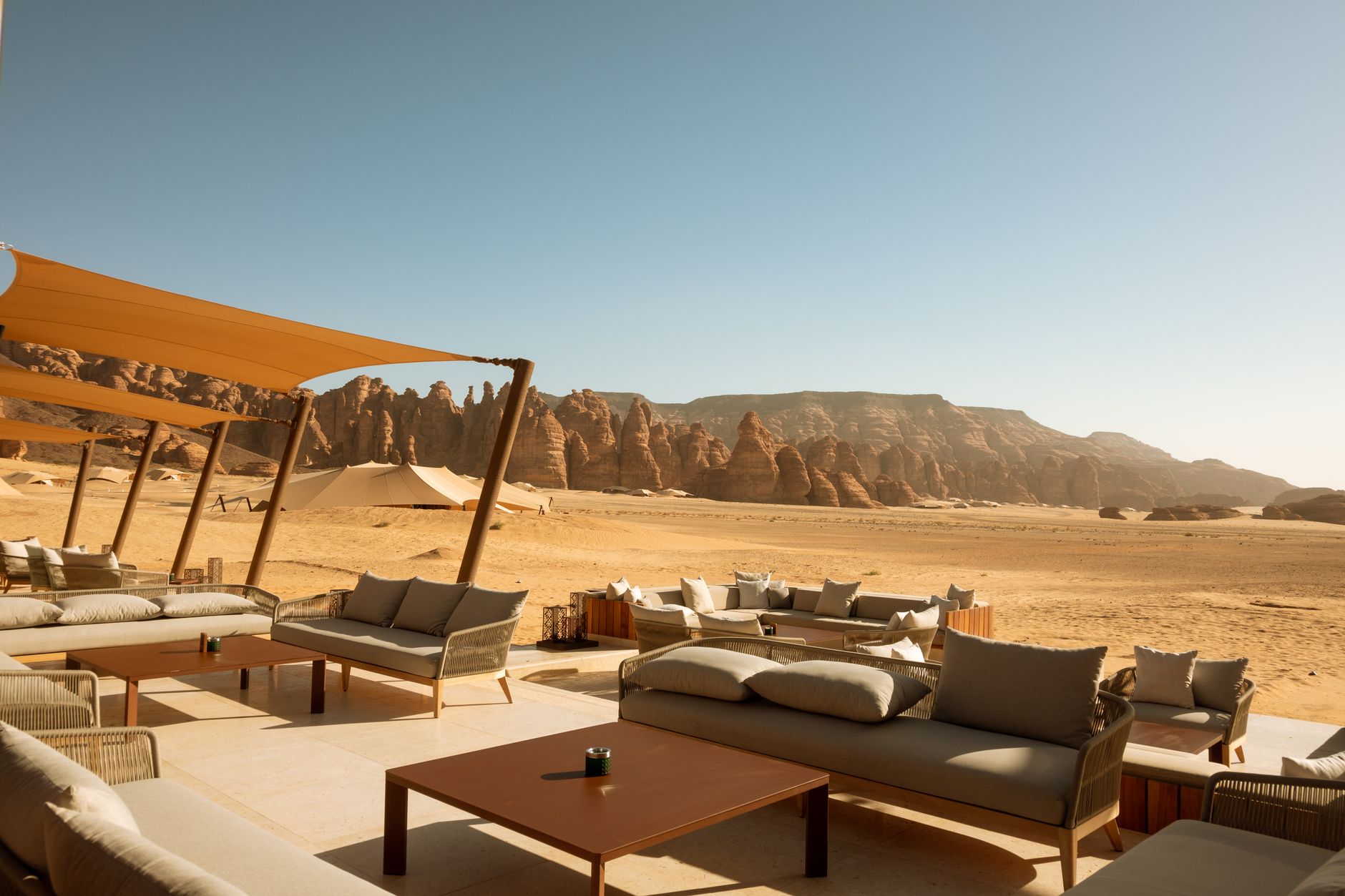
Banyan Tree AlUla is the anchor luxury property in the AlUla valley, operating since the 2020–2021 Heritage Season alongside the broader push to open Saudi Arabia’s most dramatic archaeological destination to international tourism. It sits in the Ashar Valley — a winding sandstone canyon where ochre cliffs rise sharply from desert floor — and combines Banyan Tree’s signature spa-forward hospitality with guided access to AlUla’s Nabataean heritage.
This is not a city hotel. There is no road noise, no pedestrian street to walk to dinner, and no option to step outside and hail a taxi. Every movement outside the resort requires a vehicle. If that tradeoff suits you — genuine desert immersion, a property where the landscape is the point — Banyan Tree AlUla delivers it at a high level.
Location and Setting
The resort occupies a private section of the Ashar Valley, roughly 12–15 km from AlUla Old Town by road. Sandstone formations rise directly behind the property on three sides; the open side faces the valley floor and a broad sky that makes the stargazing genuinely exceptional. There is no light pollution from AlUla town at this distance.
Hegra (Mada’in Salih), Saudi Arabia’s first UNESCO World Heritage Site, is approximately 25 km north. The resort operates transfers to the Hegra visitor centre, which is not accessible independently without a vehicle. AlUla Old Town and the canyon walks around Dadan are roughly 20 minutes south.
Room Types and Approximate Prices
Banyan Tree AlUla operates three main accommodation categories. All figures are approximate and should be verified directly at banyantree.com — Heritage Season pricing (roughly October through March) runs significantly higher than summer rates.
Desert Pavilions are the entry-level option and the most common room type at the property. Each pavilion is a tented structure on a raised platform, with canvas walls and interior finishes that run to hardwood floors, walk-in rainfall showers, and a private terrace facing the valley. Sizes range from approximately 50–75 m². Rates run from approximately SAR 2,800–3,500/night in shoulder season to SAR 3,500–5,500/night during Heritage Season as of 2026.
Sand Villas step up in space and privacy, adding a semi-private courtyard and more distance between neighbouring units. Suitable for couples seeking more seclusion without the full pool villa commitment. Approximate rates: SAR 4,000–6,500/night during Heritage Season.
Heritage Pool Villas are the flagship category: each is a standalone tented villa with a private temperature-controlled plunge pool, a dedicated outdoor terrace, and butler service. Views from the pool terrace directly face the cliff formations. Rates from approximately SAR 6,500–9,000/night as of 2026.
All room types include daily housekeeping, turndown service, and complimentary non-alcoholic beverages. Saudi Arabia does not permit alcohol sales at any accommodation.
Facilities
The central pool is an infinity-edge design that faces the valley and sandstone ridge — one of the most-photographed spots in AlUla. It is genuinely suited to daytime use from October through April; summer months (May–September) push midday temperatures to 38–45°C, making extended outdoor time impractical.
Anantara Spa offers treatment rooms in a traditional Bedouin-inspired design. Signature treatments include a desert sand body scrub and a camel milk hammam. Treatment prices run from approximately SAR 400–900 for a single session as of 2026.
The resort’s Al Wadi restaurant serves a menu combining Saudi and international dishes, with seating both indoors and on a covered terrace. Breakfast is included in most room rates; dinner for two runs approximately SAR 600–1,000 without pre-booked experiences.
A fitness centre, library lounge, and dedicated children’s programme round out the facilities. The property is family-appropriate and child-friendly.
Guided Experiences
The resort’s experience programme is one of its strongest differentiators. Guided options available as of 2026 include:
Night Stories — a sunset desert dinner experience held on the valley floor, with Bedouin storytelling, traditional music, and a set menu of Saudi dishes under lantern light. Approximately SAR 500–700 per person. Books out weeks ahead during Heritage Season.
Sunrise Camel Trek — a 60–90 minute guided ride through the valley before the heat builds, followed by a traditional Saudi breakfast. Approximately SAR 350–450 per person.
Hegra Morning Tour — the resort coordinates priority access to Hegra (Mada’in Salih), with a specialist guide who covers the Nabataean tombs and inscriptions. Transport from the resort to the Hegra visitor centre is included. Approximately SAR 450–600 per person, not including the Hegra site entry fee (approximately SAR 95 per adult as of 2026, bookable via the AlUla Royal Commission experience platform).
Stargazing Sessions — conducted from a designated dark-sky platform with a telescope and guided narration. Approximately SAR 200–300 per person.
Hot air balloon flights over AlUla depart from a nearby site during Heritage Season (typically October–March). These are coordinated through the resort concierge but are operated by third-party providers; prices run approximately SAR 1,200–1,800 per person as of 2026.
For more activities in the wider valley, see our AlUla tours guide and day trips from AlUla.
Best Time to Visit
Heritage Season (October through March) is the optimal window. Daytime temperatures run 15–28°C — comfortable for outdoor exploration. The Winter at Tantora festival (typically December–March) adds concerts, light installations, and curated events across AlUla; some performances are held adjacent to the resort’s valley location. This is peak pricing and peak demand.
April and May offer good value and still manageable temperatures (22–35°C). Fewer crowds, more availability, approximately 20–35% lower rates than peak season.
June through September is not recommended. Temperatures exceed 40°C consistently, outdoor experiences are curtailed or cancelled entirely, and the resort is operating at reduced programming. Only visit in summer if the heat does not concern you and you are taking significant advantage of the lower rates.
Getting There
AlUla is served by direct domestic flights from Riyadh (approximately 1 hour 40 minutes) and Jeddah (approximately 1 hour 15 minutes) on Saudia and flynas. Prince Abdul Majeed bin Abdulaziz Airport (ULH) is the arrival point. The resort is approximately 45–50 minutes from the airport by road.
Road transfers can be arranged through the resort (confirm rates at booking) or through private transfer services. There is no public bus or taxi infrastructure connecting the airport and the resort valley. Renting a car is a viable option if you want independence during your stay, though the resort shuttle system covers the main sites.
For broader trip context, our 3-day AlUla itinerary maps how to structure time across Hegra, Dadan, and the canyon walks. If you are comparing accommodation options across price points, our complete AlUla where-to-stay guide covers everything from desert camps to mid-range town hotels.
Who Is Banyan Tree AlUla For
The property works best for couples or small groups who want a genuinely immersive desert experience, are comfortable with the isolated setting, and have the budget for both the room rate and the experience programme. It is not the right choice if you want to walk to a restaurant, explore independently without a car, or are travelling on a tight itinerary with many different site visits — the remote location makes spontaneous movement inefficient.
For those it suits, Banyan Tree AlUla is one of the best luxury desert properties in the Arabian Peninsula. The setting is difficult to replicate.
To compare prices across all AlUla accommodation options — from mid-range town hotels to competing desert camps — Search hotels in AlUla.