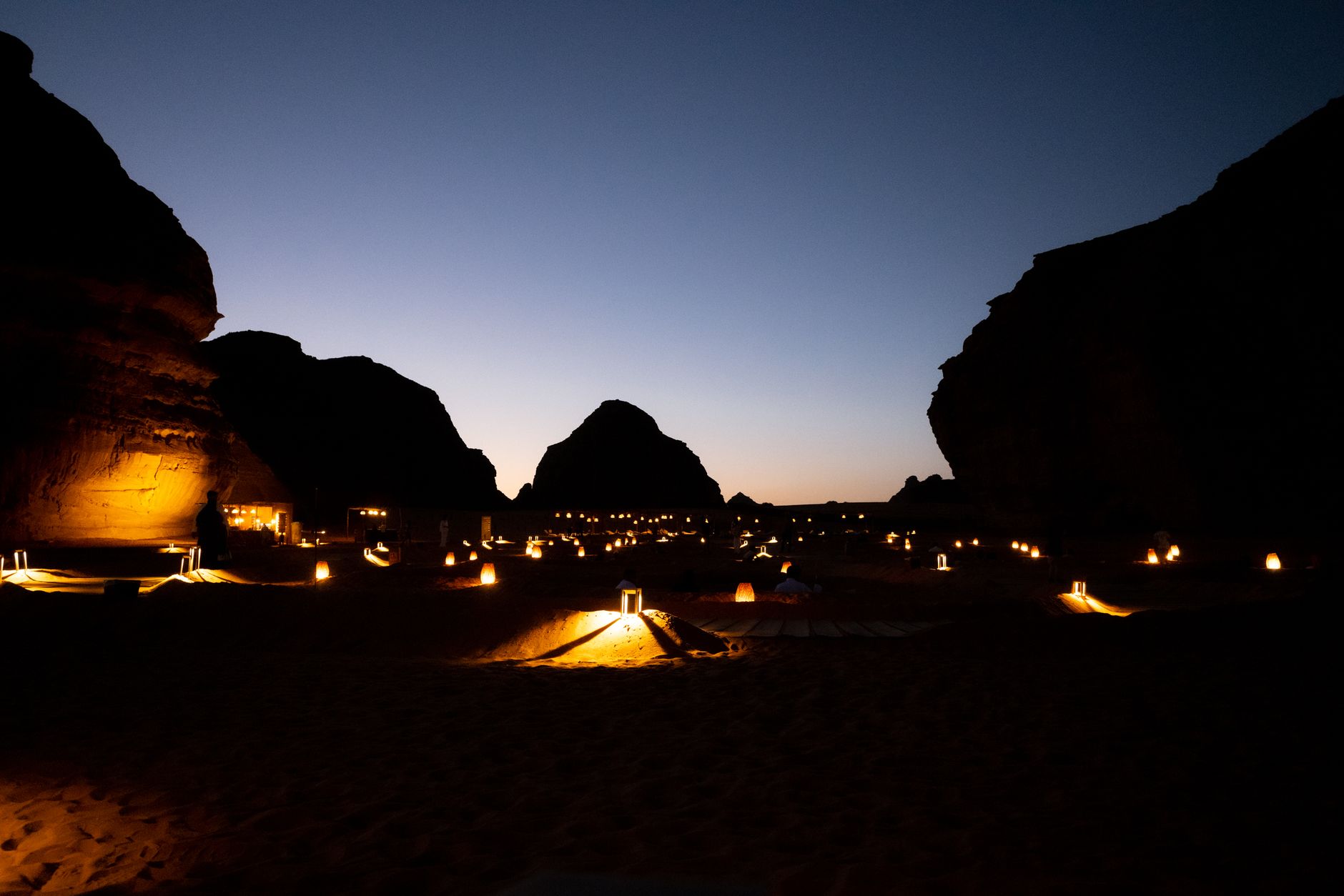
Habitas AlUla opened during Saudi Arabia’s 2020–2021 Heritage Season as one of the first purpose-built eco-luxury properties in the AlUla valley. It belongs to the Habitas group, which operates a network of community-focused camps across Mexico, Namibia, Bhutan, and other destinations where the brand’s model — sustainable construction, communal experiences, and a deliberately social atmosphere — fits the landscape.
In AlUla, that translates to a cluster of modular tent structures nestled between sandstone formations, a programme of music performances and wellness activities that form the backbone of a stay, and an operational philosophy that prioritises local employment and low-impact infrastructure over the polished formality of a conventional luxury resort.
It is not for everyone. The communal dining format and shared-experience focus mean you will interact with other guests whether or not you want to. If you are after a private, self-contained desert retreat, Banyan Tree AlUla or a pool villa at one of the larger properties is a better fit. If you want connection, atmosphere, and a programme of events rather than a menu of optional extras, Habitas delivers something genuinely different.
Location and Setting
Habitas sits in the AlUla valley approximately 15–20 km from AlUla Old Town, in a section of the landscape enclosed on two sides by eroded sandstone columns and canyon walls. The density of rock formations around the camp makes the setting more intimate than open-desert properties — at night, when the camp is lit by lanterns placed across the ground, the effect is genuinely striking.
There is no public transport access. A vehicle — either a rental car or transfers arranged through the property — is required for getting in and out and for visiting Hegra, Dadan, and the main canyon areas. The resort can arrange transfers from Prince Abdul Majeed bin Abdulaziz Airport (ULH), AlUla town, and the Hegra visitor centre.
Accommodation Types and Approximate Prices
Habitas AlUla operates in a simpler tier structure than comparable properties. The modular tent units are architecturally consistent — sustainable timber frames, natural textiles, and minimal visual footprint — with differences between categories based primarily on size and position rather than a wide gap in amenity level.
Habitat is the standard category: a tent unit of approximately 30–40 m² with a king bed, en-suite bathroom with rainfall shower, climate control (essential for shoulder season and summer visits), and a private terrace facing the surrounding rock formations. As of 2026, rates run approximately SAR 1,800 as of 2026–2,500/night in shoulder season (April–May, September–October) and SAR 2,500–4,000/night during Heritage Season (November–March).
Sanctuary units are larger — approximately 50–60 m² — and positioned for more privacy and better rock formation views. Some include a private outdoor bathing area. Approximate rates: SAR 3,500–5,500/night during Heritage Season.
Community Villa is a multi-unit configuration designed for groups of 6–10 people booking together, with a shared private terrace and dedicated support staff. Pricing is negotiated directly with the property.
All rates include access to communal dining at the main fire-and-table setup and the experience programme. This is a meaningful difference from conventional hotels: the community events are not optional extras — they are part of the stay.
Sustainability Credentials
Habitas AlUla is one of the more credibly sustainable operations in the Saudi luxury market, though the term is used loosely enough across the hospitality industry that it warrants specifics.
The property runs on a combination of solar generation and grid backup. The tent structures are prefabricated modular systems that can be dismantled and relocated without land clearing or permanent foundation work — the AlUla Royal Commission’s environmental guidelines for the valley require this from all licensed operators. Water consumption is managed through a closed-loop grey water system for landscaping.
Staffing is predominantly Saudi, with a specific programme to hire from AlUla governorate. Habitas has been transparent in its communications about this hiring target, though the precise percentage varies year to year. Local craftspeople contribute to the handmade elements throughout the camp — furniture, textiles, lanterns.
Food sourcing leans toward Saudi regional produce. The communal menu is set rather than à la carte, which reduces food waste substantially compared to a standard restaurant operation.
The Experience Programme
The experience programme is the core product at Habitas AlUla, not the accommodation. Guests who approach a stay primarily as “hotel with optional activities” tend to be less satisfied than those who book because of the programme.
Communal Dining is the centrepiece. Breakfast, lunch (where offered), and dinner are served at long shared tables around an open fire setup. The menu rotates and emphasises Saudi-inflected dishes — slow-cooked meats, flatbreads, date preparations, spiced rice dishes — alongside more broadly accessible options. This format means sharing a meal with other guests is unavoidable; for some that is the appeal.
Music Performances are scheduled throughout Heritage Season. Habitas has a track record of booking regional and international artists across ambient, electronic, and traditional Arabic music genres. Performances typically take place outside around the rock formations in the early evening. The acoustic environment — canyon walls, no ambient urban noise — makes these genuinely different from festival stages. Specific artists and dates are announced at booking and on stayhabitas.com.
Wellness sessions — yoga at sunrise, breathwork, and guided meditation — take place on a platform above the camp with rock formation views. Instructors rotate; the programme is included in the stay rate rather than priced separately.
Astronomy Sessions use the valley’s minimal light pollution for naked-eye stargazing and telescope sessions. AlUla’s skies are among the clearest in the Arabian Peninsula during the dry season. Sessions run approximately 60–90 minutes in the late evening.
Guided Rock Art Hikes cover the ancient petroglyphs carved into the valley’s canyon walls — some date back 7,000 years and predate the Nabataean occupation of the region. These are not universally offered through all AlUla properties; Habitas includes them as part of its cultural programme. Approximate duration: 2–3 hours, rated easy to moderate.
For site visits beyond the valley — Hegra, Dadan, the Elephant Rock area — see our day trips from AlUla guide and the AlUla tours overview for operator options.
Best Time to Visit
October through March is Heritage Season — the period when temperatures are comfortable for outdoor activities (15–28°C) and the full experience programme is active. The Winter at Tantora festival (typically December through March) overlaps with the property’s peak programming period; Habitas historically coordinates its own cultural events to complement rather than duplicate the broader festival schedule.
Book at least 3–6 months ahead for Heritage Season peak weeks (December, January, February around major festival events). Rates are significantly higher and availability tighter than the rest of the year.
April and May offer a transitional window with fewer crowds, reasonable temperatures (22–35°C mornings and evenings, hotter midday), and lower rates. The experience programme continues in reduced form.
June through September: avoid. Temperatures consistently exceed 40°C and outdoor programming is curtailed or suspended. The property operates at reduced capacity and the communal outdoor model loses most of its appeal in summer conditions.
Getting There
AlUla is served by direct domestic flights from Riyadh (Saudia and flynas, approximately 1 hour 40 minutes) and Jeddah (approximately 1 hour 15 minutes), arriving at Prince Abdul Majeed bin Abdulaziz Airport (ULH). Road transfer from the airport to the camp takes approximately 45 minutes.
Habitas offers airport transfers bookable through the reservation process. There is no public transport option between the airport, AlUla town, and the camp. If you plan to explore independently during your stay rather than relying solely on the resort’s programme and shuttles, renting a car at the airport gives you full flexibility.
For a broader view of how to structure an AlUla trip — including which sites to prioritise and how to divide time between Hegra, the Old Town, and the canyon areas — see our 3-day AlUla itinerary. For a comparison of all accommodation options across price points, from budget hotels in town to luxury desert resorts, the AlUla where-to-stay guide covers the full spectrum.
Who Is Habitas AlUla For
Habitas AlUla suits travellers who are comfortable with a social atmosphere and want the experience programme — the music, the communal meals, the curated events — to be the main reason they are there. It works particularly well for couples, small friend groups, and solo travellers who want the social infrastructure of a community rather than a conventional hotel’s more anonymous structure.
It is a less obvious choice for those who want complete privacy, prefer à la carte over set menus, or are primarily driven by spa facilities and room-level luxury. For those priorities, Banyan Tree AlUla or the larger resort properties in the valley are more suitable.
The sustainability model and community focus are genuinely differentiated within the Saudi luxury market. If those values matter to your choice of accommodation, Habitas makes the case for them more convincingly than most properties in the region.
To compare prices across all AlUla accommodation options — from budget town hotels to competing desert resort camps — Search hotels in AlUla.