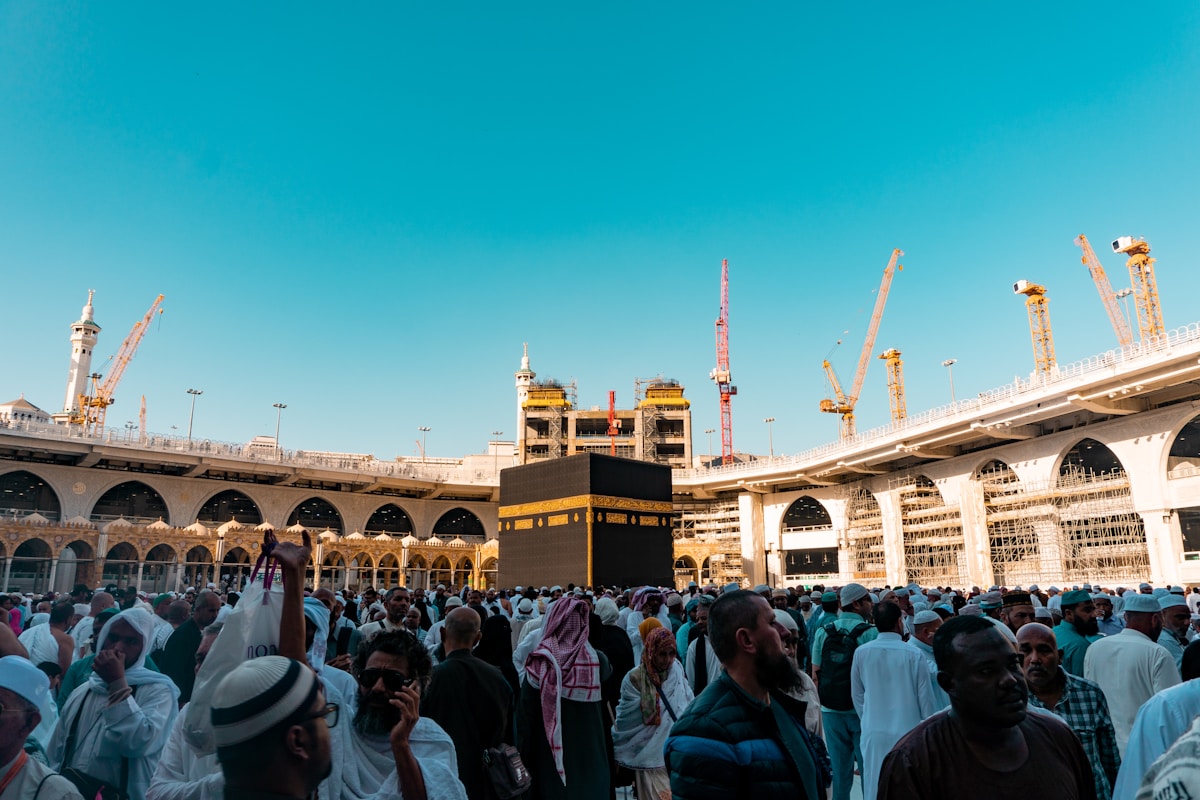
Al-Masjid al-Haram is accessible to Muslims only. Non-Muslims are prohibited from entering Mecca - enforced at all checkpoints.
Al-Masjid al-Haram - the Grand Mosque - is the largest mosque in the world and the holiest site in Islam. Built around the Kaaba, the sacred cubic structure that Muslims face during prayer, the mosque has stood in some form since the time of the Prophet Ibrahim and has been expanded by successive Islamic rulers over 14 centuries. Today it can accommodate 2.5 million worshippers simultaneously.
The Kaaba
The Kaaba is a cube-shaped stone structure approximately 15 metres high with sides of 12 by 10 metres, located at the geometric centre of Al-Masjid al-Haram. It is the most sacred object in Islam - the qibla (direction of prayer) that Muslims worldwide orient toward in their five daily prayers.
The Kaaba is draped in the Kiswah - a black cloth embroidered with Quranic verses in gold and silver thread. The Kiswah is renewed each year on the Day of Arafat (Dhul Hijjah 9) during Hajj. The old Kiswah is cut into pieces and distributed to dignitaries and Islamic institutions worldwide.
The door of the Kaaba (Bab al-Kaaba) is on the northeast face, positioned several metres above the ground - accessible by steps that are brought out for rare ceremonies. The interior of the Kaaba is not open to pilgrims; only kings and heads of state are occasionally admitted for ceremonial cleaning.
Islamic tradition on the Kaaba: The Prophet Ibrahim (Abraham) and his son Ismail are credited with constructing or reconstructing the original Kaaba. The Prophet Muhammad cleansed the Kaaba of idols in 630 CE (the year of the Conquest of Mecca) and rededicated it to monotheism.
The Black Stone
Al-Hajar al-Aswad (the Black Stone) is embedded in the eastern corner of the Kaaba at approximately waist height, encased in a silver frame. Pilgrims begin and end each circuit of the tawaf at the Black Stone - kissing or touching it is Sunnah but entirely optional given the crowds. Gesturing toward the Black Stone from a distance is also valid and equally accepted. During peak Hajj and Ramadan periods, physically reaching the Black Stone requires extraordinary patience and is not necessary for a valid tawaf.
The Black Stone’s origin has been debated - it may be a meteorite, though this is not confirmed scientifically. Islamic tradition holds that it descended from paradise and was white, darkened over time by the sins of humanity.
The Zamzam Well
The Zamzam Well is located within the mosque complex, approximately 21 metres from the Kaaba. The original well is beneath the mosque and not accessible to pilgrims directly - it is now enclosed in a basement structure. Water is pumped to taps throughout the mosque at multiple levels; pilgrims drink from these taps and fill bottles throughout their visit. The water is considered blessed, and taking Zamzam water home is a tradition observed by most pilgrims.
The well’s water originates from the Wadi Ibrahim aquifer. It has provided water without interruption through recorded history.
The Hateem
The Hateem (also called the Hijr Ismail) is a semi-circular low wall on the northwest side of the Kaaba. The enclosed area within the Hateem is considered part of the original Kaaba - it was included in the original structure built by Ibrahim and Ismail but was not incorporated in the Quraysh reconstruction due to insufficient building materials at the time. Praying within the Hateem is therefore considered equivalent to praying inside the Kaaba itself. Access to the Hateem during peak periods requires patience - the area is small and heavily sought for prayer.
Marwa and Safa: The Sa’i Corridor
The hills of Safa and Marwah are now fully enclosed within the mosque building - pilgrims perform Sa’i (the seven walks between the hills) in a wide air-conditioned gallery. The distance between the two hills is approximately 450 metres each way; seven passes cover roughly 3.15km in total. The gallery has separate tracks for those who can walk and those requiring wheelchairs. Sa’i commemorates Hagar’s search for water for her son Ishmael and is a required act of both Hajj and Umrah.
History and Expansion
The mosque has been expanded repeatedly by successive rulers:
- The Caliph Umar ibn al-Khattab conducted the first significant expansion in 638 CE
- The Abbasid Caliph Al-Mahdi expanded it in the 8th century
- The Ottoman Sultan Suleiman the Magnificent added porticoes in the 16th century
- The Saudi government has conducted three major expansion projects since 1955, dramatically increasing the mosque’s capacity
The current structure - with its distinctive clock tower minarets - is the product of Saudi construction projects from the 1980s through to the 2010s. The Abraj Al-Bait towers, including the Makkah Royal Clock Tower immediately to the north of the mosque, are the most visible element of this development: the Fairmont hotel in the main tower starts from approximately SAR 800 as of 2026 per night during non-Hajj periods, with rates rising dramatically during Ramadan and Hajj. Further expansion of Al-Masjid al-Haram is ongoing.
Search hotels in Mecca on Booking.com
Visiting Al-Masjid al-Haram
The mosque has capacity for 2.5 million worshippers simultaneously, including surrounding plazas during Hajj. Pilgrims perform tawaf (circumambulation around the Kaaba) on the Mataf - the marble floor surrounding the Kaaba - at multiple levels. The ground floor is the most traditional and brings you closest to the Kaaba; upper floors provide physical relief from crowds but are further from the Kaaba’s presence.
The mosque is open 24 hours. Night tawaf (after midnight) is significantly less crowded than during the day and is particularly worthwhile during Ramadan’s final ten nights.
For Hajj planning see the Hajj guide. For Umrah see the Umrah guide. For accommodation near the mosque see the Mecca accommodation guide.
Pilgrims travelling to Saudi Arabia should arrange travel insurance well in advance, book an airport transfer to reach Mecca or Medina without hassle, and pick up a Saudi eSIM for reliable connectivity throughout the journey.
See Also
- Mecca City Guide - transport, practical logistics, and wider Mecca sights
- Masjid al-Nabawi, Medina - the Prophet’s Mosque and what to know before visiting
- Where to stay in Mecca - hotels by distance from the Haram
- Umrah guide - the steps of Umrah, best times to perform, and booking
- Hajj guide - the annual Hajj pilgrimage and the rituals performed at this mosque
- Mecca Accommodation Guide - proximity breakdowns and booking advice