Medina is accessible to Muslims only. Non-Muslims are prohibited from entering the city - this is enforced at checkpoints.
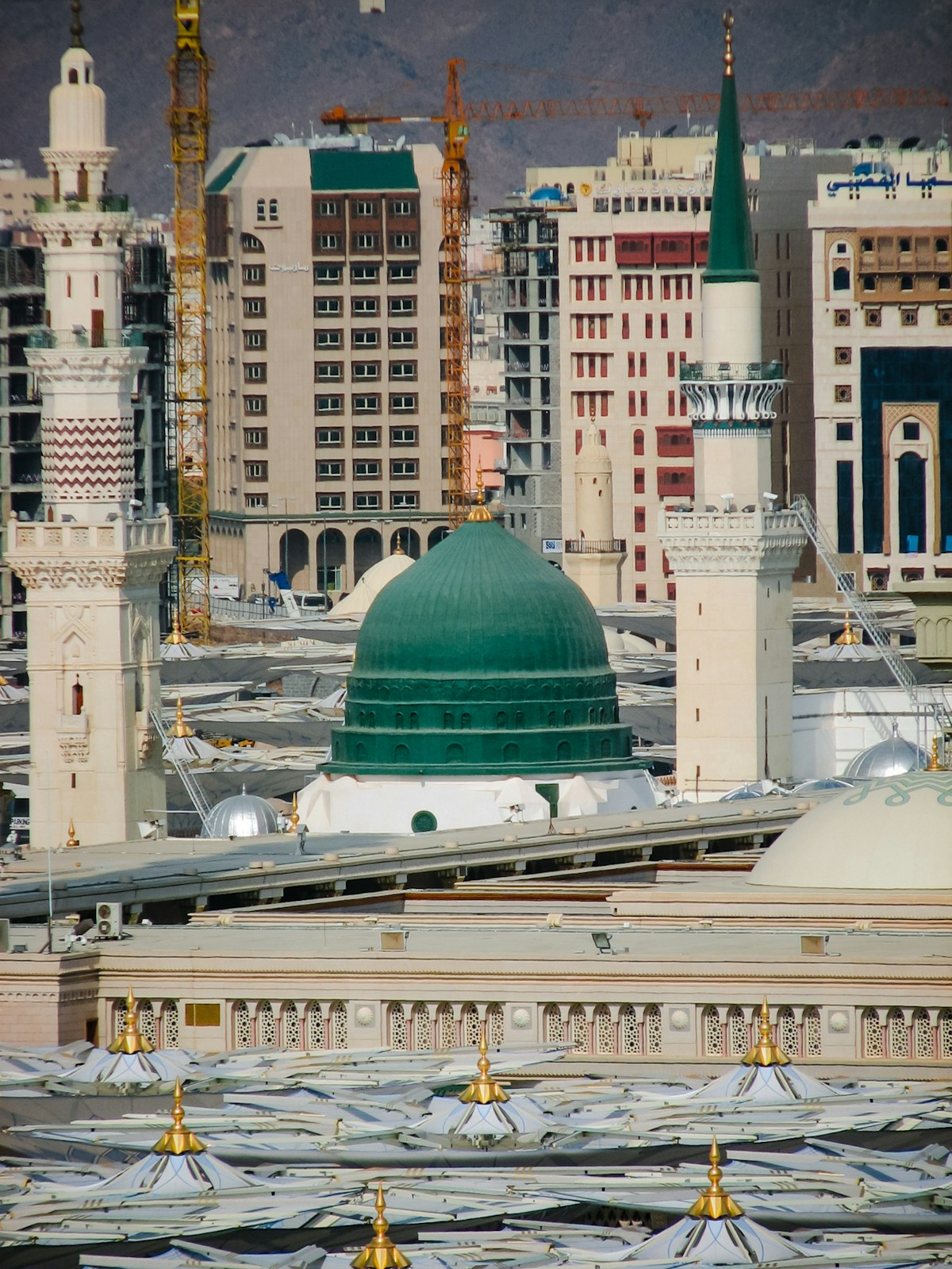
Al-Masjid an-Nabawi - the Prophet’s Mosque - is Islam’s second holiest mosque after Al-Masjid al-Haram in Mecca. It was built by the Prophet Muhammad himself in 622 CE upon his arrival in Medina following the Hijra (migration from Mecca), making it the first mosque built under prophetic authority. The Prophet is buried within the mosque, and his tomb is the primary focus of pilgrimage visits to Medina.
History
When the Prophet Muhammad arrived in Medina in 622 CE, he built the original mosque on a plot of land beside his house. The structure was simple: palm tree trunks as columns, palm fronds for the roof, and a courtyard. The Prophet prayed here, taught, and received revelations. His house was adjacent to the mosque, and when he died in 632 CE, he was buried in his room - which became incorporated into the expanding mosque.
The first caliph Abu Bakr and the second caliph Umar ibn al-Khattab are buried beside the Prophet Muhammad in the same chamber - now located under the Green Dome.
The mosque has been expanded many times by subsequent rulers. The Umayyad Caliph Umar ibn Abd al-Aziz conducted a major expansion in 706 CE. The Abbasids, Mamluks, and Ottomans all enlarged it further. The Saudi government’s 20th and 21st century expansions have dramatically increased the mosque’s capacity to over 1.5 million worshippers.
The Green Dome
The Green Dome (Al-Qubbah al-Khadra) marks the location of the Prophet’s tomb. The dome was originally white when built in the 13th century under Mamluk rule, then painted green in 1837 under the Ottomans. It is visible across Medina and is the most immediately recognisable feature of the mosque’s exterior.
The tomb chamber - the Hujra an-Nabawiyya - is enclosed by an ornate grille. Visitors approach and make salutations (salam) to the Prophet from outside the grille. Direct access to the tomb’s interior is not permitted. The Sunnah form of salutation is: As-salamu ‘alayka ya Rasulallah (Peace be upon you, O Messenger of Allah).
The Rawdah
The Rawdah (ar-Rawdah ash-Sharifah - the Noble Garden) is the area between the Prophet’s tomb and his original minbar (pulpit). Its dimensions are approximately 22 by 15 metres. The Rawdah is identifiable by its white carpets - the rest of the mosque uses red carpets - and by the original Ottoman-era columns with their distinctive decorative bases.
The Prophet described this area as a garden from the gardens of paradise. Visiting and praying here is one of the most spiritually significant acts a Muslim can perform in Medina. Access to the Rawdah is controlled due to the extraordinary demand - worshippers queue and are admitted in groups at designated times. Men and women have separate access times, and during Hajj and Ramadan, the queue can be several hours long. Visiting in the early morning or late at night typically means a shorter wait.
Al-Baqi’ Cemetery
Al-Baqi’ cemetery is directly adjacent to the mosque’s eastern gate - one of the most significant Islamic cemeteries in existence. It contains the graves of many of the Prophet’s companions (Sahaba), family members (including his daughter Fatimah and several wives), and early Muslim community members.
Access is open to men during visiting hours (generally before afternoon prayers and in the early morning). Women’s access is more restricted and varies by time of day and period of year - check current arrangements on arrival. The cemetery is sobering and moving - the graves are simple, reflecting the Islamic tradition against elaborate tomb monuments.
Quba Mosque
Quba Mosque, approximately 5km south of Al-Masjid an-Nabawi, was the first mosque in Islam - built by the Prophet Muhammad in 622 CE immediately upon his arrival in Medina, even before the Prophet’s Mosque itself. The Prophet said that praying two rakat at Quba is equivalent in reward to performing Umrah.
Getting there from the main mosque: a taxi costs approximately SAR 15 as of 2026–20 each way, or join one of the organised bus shuttles that run from the mosque area during pilgrimage periods. The mosque has been rebuilt and expanded; the current white structure dates largely from a 1986 Saudi expansion. Allow 30–45 minutes for the visit.
Other Sites in Medina
Masjid al-Qiblatayn - the Mosque of the Two Qiblas, where the direction of prayer changed from Jerusalem to Mecca during the Prophet’s lifetime, mid-prayer. The mosque is approximately 4km northwest of Al-Masjid an-Nabawi.
Mount Uhud and the Uhud battlefield - the site of the 625 CE Battle of Uhud, 5km from the mosque. The martyrs of Uhud, including the Prophet’s uncle Hamzah, are buried here. A significant site for Islamic history; the graves are simple and the battlefield landscape is preserved.
Visiting Etiquette
Dress code: Modest Islamic dress. Men should wear clean, modest clothing. Women should be fully covered with hijab. The mosque provides abaya-style coverings for women who need them at the main gates.
Behaviour: Lower your voice - the mosque is a place of worship and contemplation. Mobile phones should be silenced. Photography within the Rawdah area is restricted - follow current signage.
Salutation to the Prophet: When visiting the tomb, make salutations while facing the tomb grille. Avoid calling out loudly - quiet, personal salutation is appropriate.
Practical Logistics
Medina has a good range of hotels near Al-Masjid an-Nabawi, from budget options to premium properties. The proximity principle applies here as in Mecca: closer to the mosque means more convenient for multiple daily prayer visits. The area immediately surrounding the mosque (within 500m) is dominated by hotel towers; budget options are 1–2km from the main gates.
Search hotels in Medina on Booking.com
See the full Medina city guide for accommodation and practical logistics.
Pilgrims travelling to Saudi Arabia should arrange travel insurance well in advance, book an airport transfer to reach Mecca or Medina without hassle, and pick up a Saudi eSIM for reliable connectivity throughout the journey.
See Also
- Medina Hotels - hotels by proximity to Al-Masjid an-Nabawi
- Medina City Guide - practical logistics, Mount Uhud, and Quba Mosque
- Things to Do in Medina - Quba Mosque, Uhud, Al-Baqi’, and the city’s key sites
- Umrah Guide - combining Medina with Mecca in a single Umrah itinerary
- Hajj Guide - the annual pilgrimage and Medina’s place in it
- Al-Masjid al-Haram Guide - the Grand Mosque in Mecca alongside the Prophet’s Mosque
- Mecca vs Medina - comparing both holy cities for pilgrims
- Getting around Saudi Arabia - Haramain Railway between Jeddah, Mecca and Medina