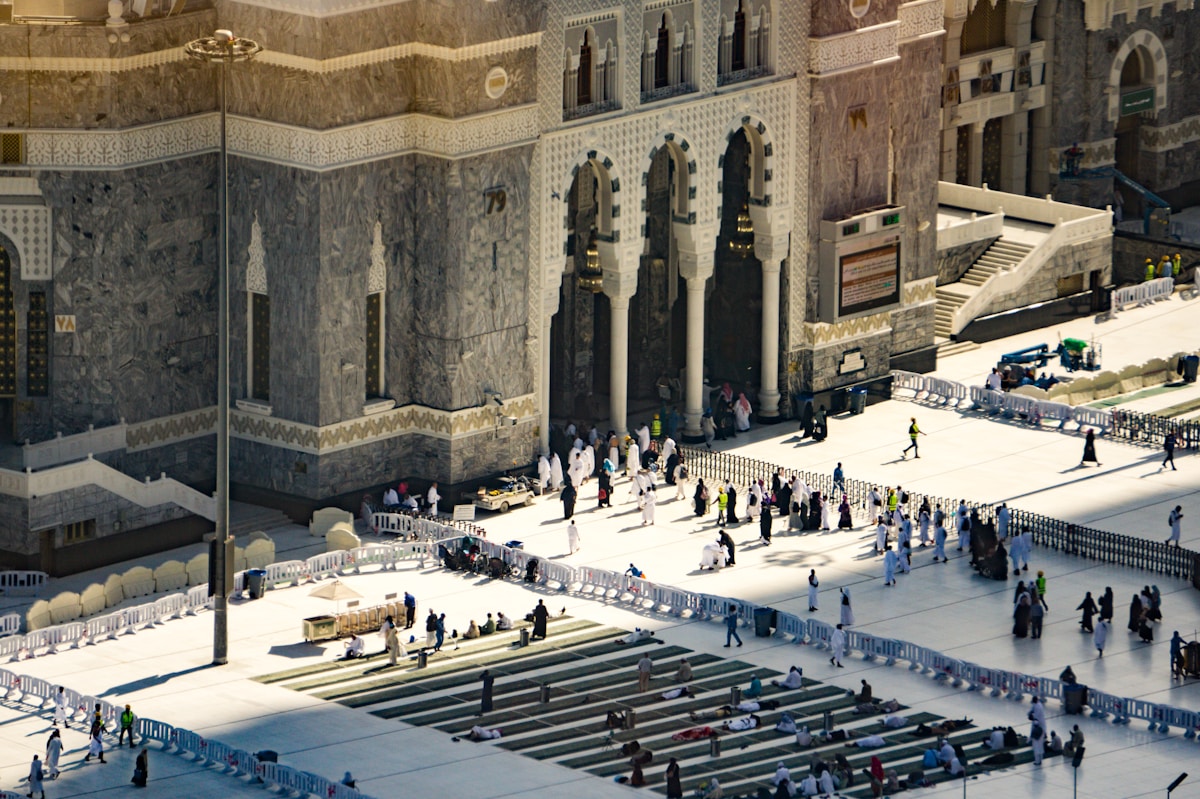
Mecca is accessible to Muslims only. Non-Muslims are prohibited from entering the city - enforced at all checkpoints on roads into Mecca.
Umrah is the voluntary pilgrimage to Mecca - a set of rituals performed at Al-Masjid al-Haram that can be undertaken at any time of year. Unlike Hajj, which is obligatory for every able Muslim and occurs on fixed dates, Umrah is sunnah (recommended) and flexible in timing. Millions of Muslims perform Umrah each year - far more than the quota-limited Hajj.
Umrah vs Hajj: The Key Differences
Obligation: Hajj is fard (obligatory). Umrah is sunnah (highly recommended but not mandatory).
Timing: Hajj occurs on fixed days of Dhul Hijjah. Umrah can be performed at any time of year except during the Hajj days themselves.
Duration of rituals: Umrah involves four core rituals and takes 3–5 hours. Hajj spans five days and involves additional rites (standing at Arafat, stoning at Muzdalifah and Mina) not present in Umrah.
Access: The same restriction applies - both are exclusively for Muslims.
The Umrah Visa
Nusuk Platform: Saudi Arabia’s official pilgrimage platform at umrahvisa.nusuk.sa allows individual booking of Umrah permits, accommodation near Al-Masjid al-Haram, and Mecca-Medina transport. This is the simplest route for independent pilgrims.
Search hotels in Mecca on Booking.com
- Processing fee: SAR 300 as of 2026 (approximately USD 80), paid through the platform
- Processing time: 1–3 business days in most cases
- Validity: 90 days from issue, multiple entries
- Separate from the standard Saudi tourist eVisa - you need either the Umrah visa from Nusuk or a tourist eVisa (some nationalities can use the tourist eVisa for Umrah - check current policy as it changes)
Authorised travel agents: Many Muslim-majority countries have Ministry of Religious Affairs-supervised Umrah agents offering package tours. These handle visa, flights, and accommodation in a single booking.
Required documentation: Passport valid 6+ months, proof of Muslim faith (required for some nationalities), for women: evidence of travel with a mahram or in an organised group where required.
Package Tours: What to Expect and What They Cost
Most pilgrims, particularly first-timers, book an Umrah package rather than arranging everything independently. Packages include flights, accommodation near Al-Masjid al-Haram, and ground transport between Mecca and Medina.
From the UK: Package prices run £800–2,500 per person. The price difference reflects accommodation proximity to the mosque - budget packages place you 1–2km from Al-Masjid al-Haram; premium packages place you in the Abraj Al-Bait complex (5 minutes’ walk from the mosque gates). Look for ATOL-bonded operators registered with the Association of British Hujjaj, such as Rayyan Travel, Olive Branch, or Al Rayyan Travel - these are examples of established UK operators, but always verify current ATOL bonding before booking.
Independent Umrah (booking separately): Cheaper overall, but requires booking flights, accommodation, and the Nusuk visa separately. Works well for experienced travellers and those with flexible schedules. The saving over a package can be £300–800 but requires more planning.
What packages typically include: Return flights from the UK, accommodation in Mecca (5–7 nights, varying proximity to the mosque), accommodation in Medina (2–4 nights for Al-Nabawi visit), Mecca-Medina ground transport, basic guidance on rituals, and sometimes a group scholar for religious guidance.
The Steps of Umrah
1. Ihram
Before crossing the miqat (the designated boundary around Mecca), the pilgrim enters the state of ihram. Men wear two white seamless cloths (izar and rida); women wear modest clothing covering everything except the face and hands. The pilgrim makes the intention (niyyah) for Umrah and recites the talbiyah:
Labbayk Allahumma labbayk, labbayk la sharika laka labbayk, innal hamda wan ni’mata laka wal mulk, la sharika lak.
In the state of ihram, certain actions are prohibited: cutting hair or nails, using perfume or scented products, engaging in sexual relations, and (for men) covering the head.
2. Tawaf (Circumambulation)
Upon arriving at Al-Masjid al-Haram, the pilgrim performs tawaf - walking seven times counter-clockwise around the Kaaba. The tawaf begins and ends at the Black Stone (Al-Hajar al-Aswad) - pilgrims touch or gesture toward it at the start of each circuit. Men perform the first three circuits at a brisk pace (raml).
After tawaf, the pilgrim prays two rakat behind the Maqam Ibrahim (Station of Abraham).
3. Sa’i (Walking between Safa and Marwah)
Sa’i commemorates Hagar’s search for water for her infant Ishmael after Abraham left them in the valley of Mecca. Pilgrims walk seven times between the two hills of Safa and Marwah - now enclosed within the mosque complex in a long air-conditioned corridor. The walk begins at Safa and ends at Marwah. Each direction is approximately 450 metres; seven passes cover roughly 3.15km in total. During the walk, pilgrims make supplication and recite Quranic verses.
4. Halq or Taqsir (Hair Cutting)
After Sa’i, the pilgrim exits ihram by having the hair shaved (halq, preferred for men) or trimmed (taqsir, at least 2.5 centimetres, for women and men who prefer not to shave). This completes the Umrah.
Best Times for Umrah
Ramadan is the most spiritually significant time to perform Umrah - the reward according to hadith is equivalent to Hajj. However, Mecca during Ramadan is at its most crowded, particularly in the final ten nights. Hotel rates are 3–5x normal rates; book 3–6 months ahead if you plan a Ramadan visit.
Rajab and Sha’ban (the two months before Ramadan) are quieter, with noticeably lower hotel rates (SAR 500–800 cheaper per night compared to Ramadan in equivalent hotels) and more manageable tawaf conditions.
November–February (non-Hajj) offers the best combination of cooler weather, moderate crowd levels, and reasonable hotel prices.
Avoid: The Hajj month (Dhul Hijjah) - Umrah is not permitted during the core Hajj days (8th–13th Dhul Hijjah), and Mecca is restricted to Hajj pilgrims during this period.
Planning Your Visit
Accommodation: Book hotels near Al-Masjid al-Haram as early as possible - proximity matters greatly as you will be performing multiple tawaf. The Mecca accommodation guide covers the key hotel zones and price ranges.
Medina: Most Umrah itineraries combine Mecca with time in Medina for visiting Al-Masjid an-Nabawi. See the Medina guide and the Al-Masjid an-Nabawi guide for information on the Prophet’s Mosque and surrounding sites.
Best time for tawaf: Late nights in Mecca are less crowded - many pilgrims prefer performing tawaf after midnight when the Mataf (circumambulation area) is more open and the atmosphere is particularly profound.
Pilgrims travelling to Saudi Arabia should arrange travel insurance well in advance, book an airport transfer to reach Mecca or Medina without hassle, and pick up a Saudi eSIM for reliable connectivity throughout the journey.
See Also
- Al-Masjid al-Haram guide - the Grand Mosque, the Kaaba, and what to know inside
- Hajj guide - the full pilgrimage rituals for Dhul Hijjah
- Saudi Arabia visa guide - Umrah visa requirements and how to apply
- Mecca City Guide - beyond the mosque: transport, accommodation, and practical logistics
- Medina City Guide - Al-Masjid an-Nabawi and combining Medina with your Umrah trip
- Mecca vs Medina - comparing both holy cities for pilgrimage planning
- Mecca Accommodation Guide - hotels by distance from Al-Masjid al-Haram