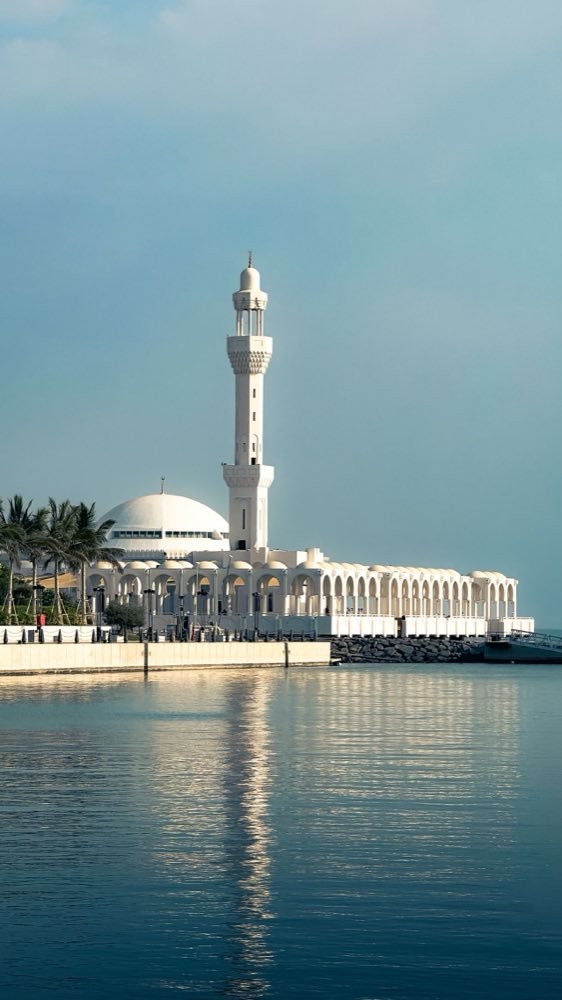
The Jeddah Corniche is the city’s front room: a long Red Sea promenade where families, joggers and visitors converge each evening. It is also where most of Jeddah’s easy, free sights sit, from the King Fahd Fountain to the Floating Mosque and an open-air collection of modern sculpture. This guide splits the waterfront into its three stretches, lists what to see in each, and covers timing, parking and safety. For the wider city, see our Jeddah travel guide and things to do in Jeddah.
If you want a guided view of the city rather than going alone, browse Jeddah tours covering the Corniche, Al-Balad and Red Sea boat trips.
North, Middle and South Corniche
Locals divide the waterfront by area rather than by official names, and the labels are used loosely.
- North Corniche: the newer, polished stretch of promenade, cafes and seafront restaurants, with the clearest sea views and the best walking surface. This is where most visitors spend their evening.
- Middle Corniche (Al Hamra): the central stretch around the King Fahd Fountain, the Floating Mosque and the outdoor sculpture collection. It is the most concentrated area for sightseeing.
- South Corniche: quieter and more local, closer to the port and Al-Balad. Less developed for visitors, but it pairs naturally with an old-town visit. See our Al-Balad walking guide.
King Fahd Fountain
The King Fahd Fountain is the headline sight. Its seawater jet is commonly cited at 312 metres, the tallest fountain in the world, and it is visible from many kilometres along the coast. After dark it is lit by hundreds of spotlights.
Sources disagree on exact operating hours, so treat the schedule as approximate: the display is an evening attraction from around sunset until after midnight, and it can stop for maintenance or unsafe wind. Viewing is free. The closest and most impressive angle is from the Al Hamra waterfront opposite the jet; from the North Corniche you see it at a distance with a long walk along the water. Boat trips from marked jetties pass close to the base, and rooftop restaurants on the seafront give an elevated view.
Floating Mosque (Al Rahma)
The white Al Rahma Mosque stands on piles over the water, which is why it appears to float at high tide. It is the Corniche’s best photograph, especially in late afternoon light. Visitors are generally welcome to see the exterior and take photos in modest dress. Avoid the five daily prayer times, and expect interior access to be restricted; hours and rules are not published officially, so check on the day.
A note on access, because it confuses many first-time visitors: the Floating Mosque is an ordinary Jeddah attraction. Mecca remains closed to non-Muslims, with checkpoints on the approach roads, and non-Muslims visiting from Jeddah should not drive towards it. See our Mecca vs Medina guide for the access rules.
Open-air sculptures
Along the Al Hamra stretch you will find a collection of large modern sculptures, sometimes called the Jeddah open-air sculpture museum. Works by artists including Henry Moore, Joan Miro, Alexander Calder and Victor Vasarely were brought to the city from the 1970s and have been restored and relocated to the waterfront. Entry is free and the pieces sit among paths and lawns, so a slow circuit takes about 45 to 60 minutes. Counts differ between sources, so do not rely on a fixed number of works.
Fakieh Aquarium
The Fakieh Aquarium on the Corniche is the main paid indoor stop and a reliable option for families and for the hottest hours. Reported prices run from roughly SAR 50 to 85 for the dolphin show alone and about SAR 119 to 139 for the aquarium and show combination, as of 2026. Hours and weekend ticket validity are inconsistent between listings, so book through the official site or a ticketing platform and check the day you plan to go. More family planning is in our Saudi Arabia with kids guide.
Sunset timing, parking and getting there
- Timing: arrive about an hour before sunset, walk the sculptures and Floating Mosque in the golden light, then stay for the fountain after dark. Thursday and Friday evenings are the busiest; midweek is calmer.
- Heat: from June to September, afternoons are severe. Go after sunset and carry water. November to March is the comfortable season, and the Corniche then runs busy at all hours.
- Parking: there are free roadside and lot spaces along the waterfront, but they fill up on weekend evenings. Arriving before 6pm or using Uber or Careem avoids the problem. Our Jeddah airport transfer guide covers getting in from King Abdulaziz Airport.
- Safety: the Corniche is family-oriented, well lit and busy late. Take ordinary precautions, keep valuables out of parked cars and stay on the main promenade after dark.
- Dress and photography: modest dress is expected near the mosque. Do not photograph families without permission.
Where to stay and what to combine
Staying near the North Corniche makes the evening walk effortless; see our where to stay in Jeddah guide or check Jeddah hotels on Booking.com for current rates. For evening plans beyond the waterfront, read Jeddah entertainment. For official visitor information, see Visit Saudi.