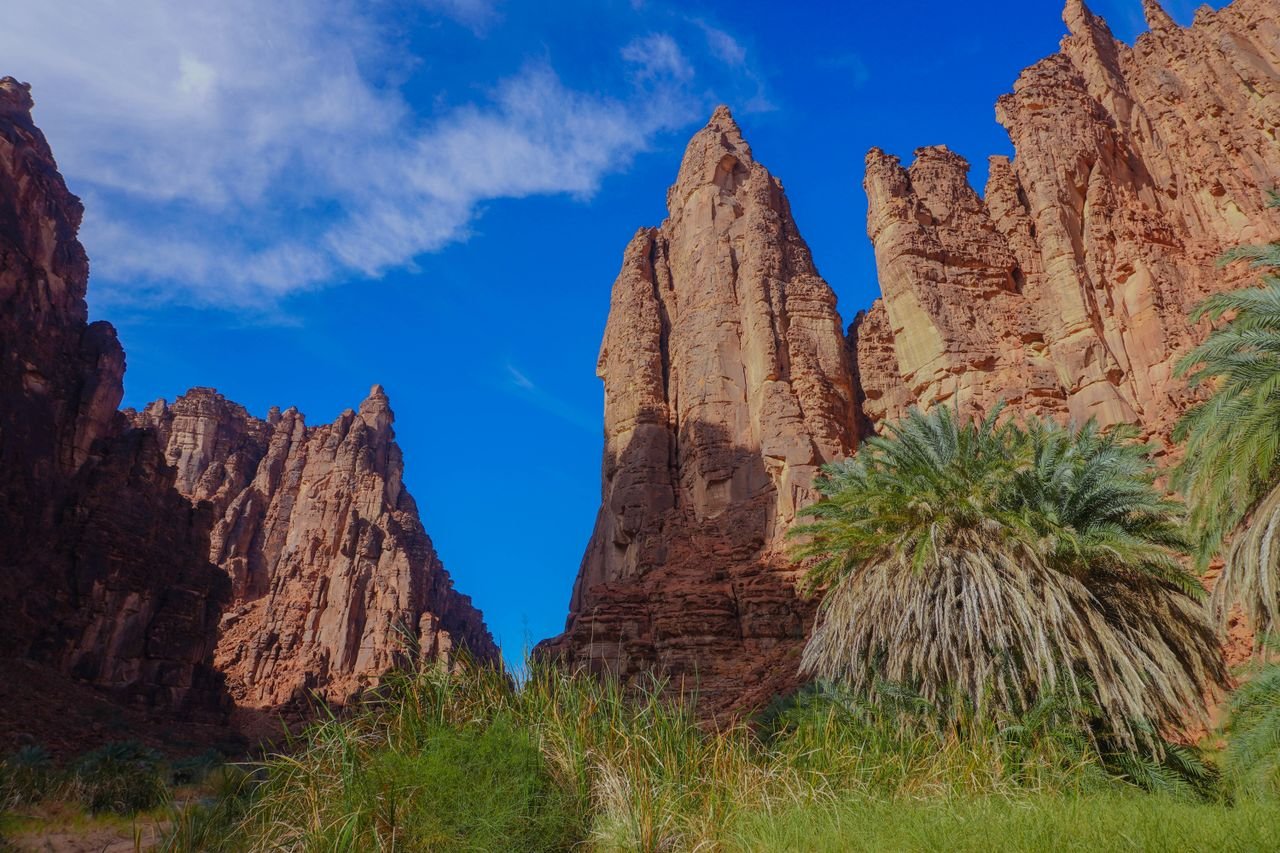
Wadi Disah (also written Wadi Al Disah or Wadi Disah) is a green sandstone canyon in Tabuk province, in the northwest corner of Saudi Arabia. Red cliffs rise several hundred metres on both sides of a valley floor of date palms, reeds and, in places, running water. It is the best natural day out in the northwest, yet it is still far less visited than AlUla, 3 hours to the south. We cover how to reach it from both bases, what the 4x4 section involves, and when not to go.
Quick facts
| Location | Tabuk province, northwest Saudi Arabia |
| From Tabuk | About 250 to 260 km, roughly 2.5 to 3 hours via Route 8900 |
| From AlUla | About 260 km, roughly 3 hours; some routes run longer |
| Vehicle | Car to the first entrance; 4WD for the second entrance and inner canyon |
| Best months | November to March |
| Time needed | A full day; overnight is better |
| Local guide | Approximately SAR 200 to 300 per vehicle (as of 2026, negotiated) |
Distances vary by source and by where you start in town. Treat every figure here as approximate and check it against your map app on the day.
Getting there from Tabuk
Tabuk is the closest base. Drive south and then west on Route 8900 for roughly 250 to 260 km, which takes about 2.5 to 3 hours in normal conditions. The road is paved to the village area. Fuel up in Tabuk before you leave and carry water, because services are thin once you leave the main road.
Our Tabuk city hub and things to do in Tabuk quote shorter distances for the same trip. The route figures above are the more cautious ones, so plan around them. Hire a car for the day if you want the freedom to stop: compare car hire in Saudi Arabia. If you would rather not drive, browse Tabuk tours for a guided day that includes the 4x4 section.
Tabuk has an airport with domestic flights. Fares from Riyadh and Jeddah are often reported around $30 to 50 each way on the low-cost carriers, which is approximate and moves with the date; see our flights to Saudi Arabia guide for how domestic booking works. Where to stay in Tabuk covers the night before and after.
Getting there from AlUla
AlUla is the other common base, and most visitors on a northwest loop do the canyon from here. The drive is about 260 km and takes around 3 hours each way, so a self-drive day means 6 hours at the wheel. Guided tours handle this with a pick-up from your hotel and a 4x4 for the canyon, and they are the practical choice if you are already booking Hegra. Browse AlUla tours to see the Wadi Disah departures, and read our AlUla activities guide for what else to fit into your stay. If you are linking AlUla and Tabuk, allow a night in between instead of a double drive.
The two entrances and the 4x4 section
Visitors usually reach the canyon via the village at its mouth. A normal car can generally get that far, and you can walk in from the first entrance on foot to see the lower canyon, its palms and its cliffs.
The second entrance is the one that needs 4WD. Beyond it the paved road gives way to a sand and gravel track with seasonal water crossings and uneven surfaces. Local drivers with jeeps wait at the entrance, and the standard arrangement is a negotiated run through the canyon.
Guide cost. Reports suggest approximately SAR 200 to 300 per vehicle for a canyon circuit, shared between passengers. This is an approximate figure as of 2026; agree the price, the route and the return time before you get in. Do not drive a two-wheel-drive rental onto the track, because getting stuck here means a long wait for recovery.
Best time to visit and flash-flood risk
November to March is the window. Daytime temperatures are comfortable, the light is soft in the morning, and the palms are at their greenest. June to August should be avoided, with heat regularly passing 40 C.
The same cooler months carry the flash-flood risk. Rain that falls in the hills upstream can send water through the canyon floor with little warning, even when the sky above you is clear. Check the forecast for the whole region before you set off. If rain is expected, do not go in; the track can be impassable for a day or more afterwards. Our monthly guides for November and December cover the weather you can expect.
What to do in the canyon
Walk the valley floor. Hiking the canyon takes anywhere from two to four hours, depending on how far in you go and how long you stop for photographs. The best views are of the cliffs rising above the palm groves.
Camp. Basic camping is possible among the boulders and palms. Bring everything: water, food, warm layers for the night and a way to carry out your rubbish. A guide or driver can usually advise on a safe spot away from the lowest ground. See our desert camping guide for kit and etiquette.
Photograph at the right hours. Early morning or late afternoon gives the warm red tones. At midday the canyon floor is in shade and the colours flatten.
Practical tips
- Download an offline map; signal is patchy in the canyon.
- Carry at least 3 litres of water per person and a full tank of fuel.
- Wear shoes with grip; sand, rock and wet reeds mix underfoot.
- Dress modestly. Locals use the canyon for picnics and farming.
- Leave no rubbish, and do not climb or damage the palms.
- Tell someone your route if you are driving yourself.
Sources and further reading
For more route detail and photographs, see the House of Saud guide to Wadi Disah and the On The Way Around guide. Both were written by independent travellers; costs and access arrangements change, so confirm locally.
Looking for quieter destinations? See 6 underrated places in Saudi Arabia.