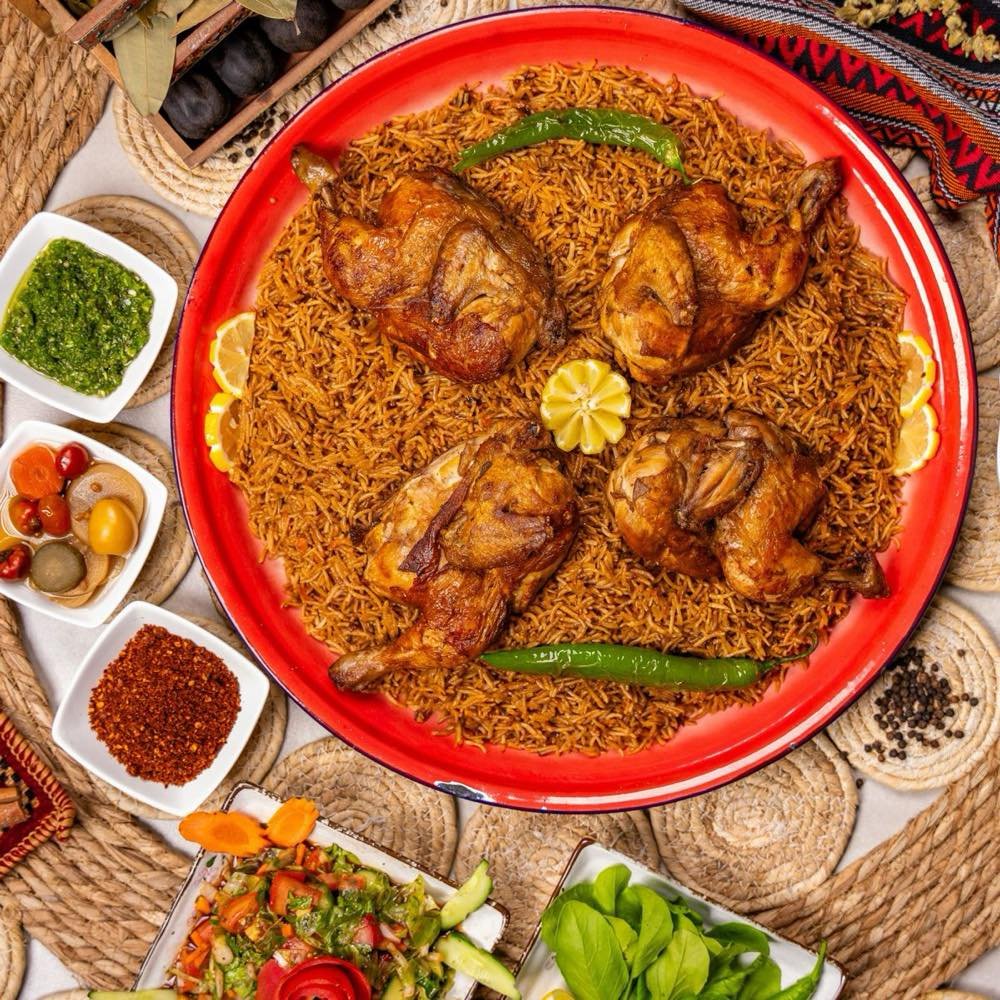
The 10 dishes to try in Saudi Arabia are kabsa, mandi, jareesh, harees, saleeg, mutabbaq, machboos, Asir honey with thareed, samboosa and luqaimat. Together they cover the central desert, the Red Sea coast, the Gulf coast and the southern mountains. Typical prices run from SAR 5 for street snacks to SAR 80 for a full rice platter as of 2026.
For the wider picture of regional cooking, read our Saudi Arabian food guide.
The ten dishes at a glance, with typical prices as of 2026:
| Dish | Region | Typical price |
|---|---|---|
| Kabsa | National dish, central | SAR 40-80 a plate; SAR 80-150 for a platter for 4-6 |
| Mandi | Southern Arabia | SAR 60-100 per person |
| Saleeg | Medina area | SAR 40-60 a portion |
| Mutabbaq | Jeddah, Al Balad | SAR 15-25 |
| Machboos | Gulf coast, Eastern Province | Seafood platter for two in Al Khobar SAR 80-150 |
| Asir honey with thareed | Asir mountains | Bani Saad honey SAR 300-800 per kg |
| Samboosa | Nationwide | SAR 5-10 each |
| Luqaimat | Nationwide dessert | SAR 15-25 a portion |
| Jareesh and harees | Najd; harees mainly in Ramadan | See the sections below |
1. Kabsa
Saudi Arabia’s national dish is basmati rice cooked in a meat broth with cardamom, cinnamon, cloves and dried black lime (loomi), topped with lamb or chicken. It arrives on a shared platter with tomato sauce (daqqus) and salad. A plate costs approximately SAR 40 to 80; a platter for four to six people costs approximately SAR 80 to 150.
Local tip: order one platter for the table rather than individual plates, because that is how the dish is meant to be eaten.
Find a good kabsa house in our Riyadh food guide or on a Riyadh food tour.
2. Mandi
Mandi comes from the southern Arabian Peninsula. Whole lamb or large chicken pieces cook for four to six hours in a sealed pit over wood, and the rice takes on smoke and fat. Expect approximately SAR 60 to 100 per person at a dedicated mandi restaurant.
The Abha food guide lists where to find it in the Asir highlands, and our Abha food tour puts it in context.
3. Jareesh
Jareesh is cracked wheat slow-cooked with meat into a thick porridge, seasoned with fried onion and dried yoghurt, with a slightly sour edge. It is the oldest Najdi recipe still in common use and started as a food for desert travel. A portion costs approximately SAR 25 to 35 at traditional Najdi restaurants in Riyadh.
See where to eat in Riyadh for restaurant picks.
4. Harees
Harees is whole wheat cooked with meat until both break down into a smooth mass. It is the standard Ramadan iftar dish across Saudi Arabia and the Gulf and appears at weddings and national celebrations, but rarely on regular menus.
Local tip: if you want to try it, travel during Ramadan, when hotels and restaurants serve it from sunset.
5. Saleeg
Saleeg is white rice cooked in chicken or lamb stock and finished with milk, giving a creamy, mild result. It comes from the Medina area and is served with roasted chicken and spiced tomato sauce. A full portion costs approximately SAR 40 to 60.
Non-Muslim visitors can enter Medina but not the haram zone around Masjid al-Nabawi. Our Medina food guide maps the restaurants outside that zone.
6. Mutabbaq
Mutabbaq is a folded pancake stuffed with egg, minced meat and spring onion, brought by South Asian traders and now a Jeddah street-food staple. In Al Balad it costs approximately SAR 15 to 25.
Local tip: Harah Bakery in Al Balad opens from around 7am, so breakfast there before the lanes get busy. Pair it with our Al Balad walking guide and the Jeddah food guide, or book a Jeddah food tour.
7. Machboos
Machboos is the Gulf version of kabsa, often made with fish or shrimp in a tamarind-spiced broth. Fresh Gulf shrimp, hammour (grouper) and kingfish are served grilled or fried along the Eastern Province coast. A seafood platter for two in Al Khobar costs approximately SAR 80 to 150.
Our Al Khobar food guide and Dammam food guide cover the restaurants.
8. Asir honey with thareed
The mountain south has Saudi Arabia’s most distinct regional food. Asir honey (asali) is the prized product, with Bani Saad honey selling for approximately SAR 300 to 800 per kilogram. It is eaten with thareed (bread soaked in meat broth) or as a dip alongside marga, a thin meat stew. Sorghum flatbread replaces wheat bread in the mountains.
Local tip: the Honey Cottage near Rijal Almaa lets you sample around 40 honey varieties for about SAR 10 on top of the base ticket (as of 2026; confirm on arrival). See our Rijal Almaa guide and Abha tours.
9. Samboosa
Samboosa are fried triangular pastries filled with meat, cheese or vegetables, sold across the country for approximately SAR 5 to 10 each. They are a fast breakfast or snack, and the closest thing to a national street food. Falafel (SAR 3 to 8) and shawarma (SAR 10 to 20) fill the same role.
10. Luqaimat
Luqaimat are small fried dough balls soaked in date honey or syrup, the most common Saudi dessert. A portion costs approximately SAR 15 to 25. Eat them warm, with Arabic coffee.
Where to start
Most visitors eat well in Riyadh and Jeddah, where traditional restaurants sit beside international ones. Browse hotels in Riyadh or hotels in Jeddah, then add a Riyadh tour or Jeddah tour that includes a meal.